
© Marine Duforêt
COLLECTIBLE Three questions to
Lisa Bravi & Romain Joly
March 2026
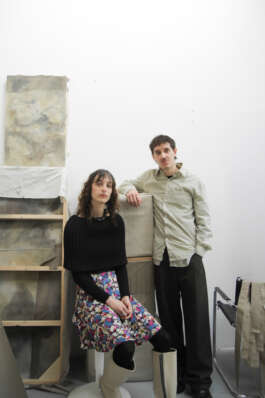
Today, we’re excited to speak with Lisa Bravi and Romain Joly , scenographers for the CURATED section of COLLECTIBLE Brussels 2026. Working alongside curator Marine Mimouni, they are shaping the spatial identity of this year’s theme: Echoes of Use, a poetic exploration of how furniture preserves the memory of our interactions.
COLLECTIBLE: Your practice draws from everyday architectural fragments. How does this influence your approach to scenography for the Curated section?
Lisa Bravi & Romain Joly: Indeed, we work from elements that draw on a collective memory: ordinary, banal forms that are both intimate and universal. These forms are mimetic: they act like a trompe-l’œil, but the change of material, with the shift to textile, allows the gaze directed at these objects to be displaced, enabling them to be seen and understood differently. Their power lies in their familiarity.
For the scenography of Curated, we created boxes in pleated fabric, in collaboration with the Lognon atelier. The box is a standard, functional object: it is used to pack, protect, and move things. The closed boxes are not only plinths; they accompany the pieces and take part in their narrative. Through their presence, they suggest a story, a context, a before or an after, and are part of an engaging architectural dialogue we developed with the curator, Marine Mimouni.
They are boxes, or almost. The object is not quite what it seems to be. It is precisely this in-between that interests us.
C: The theme “Echoes of Use” speaks of memory and traces of life. How did this concept guide your creative decisions in shaping the installation’s overall structure and atmosphere?
LB & RJ: The installation does not seek to fix the objects in a definitive presentation, but rather to evoke the provisional state of moving, almost fragile, where everything could still be moved, opened, or reorganized. This sense of instability resonates with Echoes of Use: the objects exist within a moving temporality.
The scenography becomes a receptacle for domestic narratives, embodied by around fifty emerging and mid-career designers, including Kim Haagen, Kyunchul Kim, Silvia Sukopova, and Franz Ehn. The structures function both as display supports and as narrative devices. They frame a reflection on intimacy, memory, and the domestic sphere, at the heart of the theme developed by the curator.
C: As visitors move through the space, what gestures, movements, or reflections do you hope the scenography encourages in relation to the objects and designers presented?
LB & RJ: The closed boxes create a little frustration: they suggest something inside, yet it remains hidden. We are drawn to this tension. It reinforces the feeling of a move in progress, where everything seems to be waiting.
There is also the idea of the disorder inherent to such a moment, something less polished, less fixed. Elements can be moved, stacked, or opened. The scenography is deliberately unfinished, as if one had arrived in the middle of an ongoing process. It encourages a freer, more dynamic relationship with the objects.
© Marine Duforêt
COLLECTIBLE Three questions to
Lisa Bravi & Romain Joly
March 2026
Today, we’re excited to speak with Lisa Bravi and Romain Joly , scenographers for the CURATED section of COLLECTIBLE Brussels 2026. Working alongside curator Marine Mimouni, they are shaping the spatial identity of this year’s theme: Echoes of Use, a poetic exploration of how furniture preserves the memory of our interactions.
COLLECTIBLE: Your practice draws from everyday architectural fragments. How does this influence your approach to scenography for the Curated section?
Lisa Bravi & Romain Joly: Indeed, we work from elements that draw on a collective memory: ordinary, banal forms that are both intimate and universal. These forms are mimetic: they act like a trompe-l’œil, but the change of material, with the shift to textile, allows the gaze directed at these objects to be displaced, enabling them to be seen and understood differently. Their power lies in their familiarity.
For the scenography of Curated, we created boxes in pleated fabric, in collaboration with the Lognon atelier. The box is a standard, functional object: it is used to pack, protect, and move things. The closed boxes are not only plinths; they accompany the pieces and take part in their narrative. Through their presence, they suggest a story, a context, a before or an after, and are part of an engaging architectural dialogue we developed with the curator, Marine Mimouni.
They are boxes, or almost. The object is not quite what it seems to be. It is precisely this in-between that interests us.
C: The theme “Echoes of Use” speaks of memory and traces of life. How did this concept guide your creative decisions in shaping the installation’s overall structure and atmosphere?
LB & RJ: The installation does not seek to fix the objects in a definitive presentation, but rather to evoke the provisional state of moving, almost fragile, where everything could still be moved, opened, or reorganized. This sense of instability resonates with Echoes of Use: the objects exist within a moving temporality.
The scenography becomes a receptacle for domestic narratives, embodied by around fifty emerging and mid-career designers, including Kim Haagen, Kyunchul Kim, Silvia Sukopova, and Franz Ehn. The structures function both as display supports and as narrative devices. They frame a reflection on intimacy, memory, and the domestic sphere, at the heart of the theme developed by the curator.
C: As visitors move through the space, what gestures, movements, or reflections do you hope the scenography encourages in relation to the objects and designers presented?
LB & RJ: The closed boxes create a little frustration: they suggest something inside, yet it remains hidden. We are drawn to this tension. It reinforces the feeling of a move in progress, where everything seems to be waiting.
There is also the idea of the disorder inherent to such a moment, something less polished, less fixed. Elements can be moved, stacked, or opened. The scenography is deliberately unfinished, as if one had arrived in the middle of an ongoing process. It encourages a freer, more dynamic relationship with the objects.
