
© Marita Francescon
COLLECTIBLE In-Depth
Marita Francescon
March 2026
This series, COLLECTIBLE In-Depth, unveils the backstage of contemporary creation. Tackling various topics from personal designer processes to the position of collectible design on the global design market, COLLECTIBLE In-Depth offers different views to suit all tastes. Today we speak with Marita Francescon.
COLLECTIBLE: Why do you focus on contemporary collectible design? What does it mean to you?
Marita Francescon: I focus on contemporary collectible design because it enables experimentation and creativity without the limits imposed by industrial processes. It allows me to explore ideas, forms, and meanings. I strongly believe in collaborating with Italian artisans whose generational expertise adds depth and authenticity to every work.
My design research aims to shift the traditional paradigm of design: not just form and function, but objects that communicate and establish an emotional and psychological dialogue with the viewer. I strive to create pieces that can resonate with a person’s inner state, spark reflection, and even influence mood — works that are not only used or observed, but truly experienced.
C: Can you talk about a new piece or collection you are presenting at COLLECTIBLE this year?
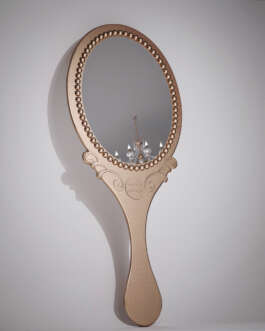
MF: The You Are Enough collection, inspired by vintage beauty sets, stems from a dual reflection: on the importance of reminding ourselves every day to engage in small, simple gestures connected to our well-being, and on the need to remain centered despite the constant media bombardment we are subjected to in every area of our lives—a narrative that implicitly tells us we are never quite enough: not aesthetically, not professionally, not as parents, always suspended between duties and expectations. Conceived as an emotional dialogue between the design object and its user, the series expresses the need to remind each of us—anyone reading this interview included: “Yes, you are enough.”
C: What have you been up to recently? What are the next projects or exhibitions you wish to highlight?
MF: Recently, I worked on the design of the new ticket office and info point at the Sansevero Chapel Museum in Naples, a Baroque jewel that houses masterpieces including the celebrated Veiled Christ sculpture. Among the elements I designed is a custom brass counter produced from my drawings by the Italian company De Castelli, featuring a pattern derived from the museum’s original 18th-century labyrinth floor. I had already incorporated this distinctive motif into the custom furnishings I designed for the bookshop, and later reinterpreted it in a contemporary way for the museum’s new executive offices, where I designed bespoke gres flooring manufactured specifically for the project by the Italian company Refin.
C: Who has mentored or influenced your practice?
MF: More than being shaped by a single individual, my practice has been influenced by an inner need for creative expression, coupled with a desire to communicate and convey emotions. I believe my father, an engineer, has played a role in shaping my attention to function as well as form, and in my constant habit of reflecting on the technical aspects of my work. My years at the Faculties of Architecture in Naples and Madrid were also fundamental, as were my experience at IED Design in Barcelona, my second degree in Communication Sciences, and more recently my in-depth study of art history and artistic techniques. It is from this blend of architecture, design, communication, and art that the main influences on my practice emerge.
C: How has your practice evolved since you started working in collectible design?
MF: Compared to my first collections presented at SaloneSatellite in Rho Milan — mainly pop-inspired furniture rooted in emotional design and created to convey positive energy and joy — my practice has gradually evolved toward a more reflective, narrative dimension. Over time, I moved beyond purely immediate emotional impact to create pieces that not only feel expressive or playful, but also engage the viewer in dialogue. My approach has shifted from instinctive and emotive to more conscious and questioning, aiming not just to please, but to provoke thought and invite interpretation.
C: Where do you take your inspiration from?
MF: I draw inspiration from the world of art, which I have been passionate about since childhood. When I need to reconnect with myself, I love visiting exhibitions and museums alone. In the silence of contemplating artworks—in the search for meaning, in the process of decoding them, and in opening myself to the emotions they convey—I find both nourishment and inspiration. I am particularly fascinated by current research in neuroscience on the power of art and aesthetic experiences to measurably change the body, the brain, and behavior. I firmly believe that artistic experience can improve people’s well-being.

© Marita Francescon
© Marita Francescon
COLLECTIBLE In-Depth
Marita Francescon
March 2026
This series, COLLECTIBLE In-Depth, unveils the backstage of contemporary creation. Tackling various topics from personal designer processes to the position of collectible design on the global design market, COLLECTIBLE In-Depth offers different views to suit all tastes. Today we speak with Marita Francescon.
COLLECTIBLE: Why do you focus on contemporary collectible design? What does it mean to you?
Marita Francescon: I focus on contemporary collectible design because it enables experimentation and creativity without the limits imposed by industrial processes. It allows me to explore ideas, forms, and meanings. I strongly believe in collaborating with Italian artisans whose generational expertise adds depth and authenticity to every work.
My design research aims to shift the traditional paradigm of design: not just form and function, but objects that communicate and establish an emotional and psychological dialogue with the viewer. I strive to create pieces that can resonate with a person’s inner state, spark reflection, and even influence mood — works that are not only used or observed, but truly experienced.
C: Can you talk about a new piece or collection you are presenting at COLLECTIBLE this year?
MF: The You Are Enough collection, inspired by vintage beauty sets, stems from a dual reflection: on the importance of reminding ourselves every day to engage in small, simple gestures connected to our well-being, and on the need to remain centered despite the constant media bombardment we are subjected to in every area of our lives—a narrative that implicitly tells us we are never quite enough: not aesthetically, not professionally, not as parents, always suspended between duties and expectations. Conceived as an emotional dialogue between the design object and its user, the series expresses the need to remind each of us—anyone reading this interview included: “Yes, you are enough.”
C: What have you been up to recently? What are the next projects or exhibitions you wish to highlight?
MF: Recently, I worked on the design of the new ticket office and info point at the Sansevero Chapel Museum in Naples, a Baroque jewel that houses masterpieces including the celebrated Veiled Christ sculpture. Among the elements I designed is a custom brass counter produced from my drawings by the Italian company De Castelli, featuring a pattern derived from the museum’s original 18th-century labyrinth floor. I had already incorporated this distinctive motif into the custom furnishings I designed for the bookshop, and later reinterpreted it in a contemporary way for the museum’s new executive offices, where I designed bespoke gres flooring manufactured specifically for the project by the Italian company Refin.
C: Who has mentored or influenced your practice?
MF: More than being shaped by a single individual, my practice has been influenced by an inner need for creative expression, coupled with a desire to communicate and convey emotions. I believe my father, an engineer, has played a role in shaping my attention to function as well as form, and in my constant habit of reflecting on the technical aspects of my work. My years at the Faculties of Architecture in Naples and Madrid were also fundamental, as were my experience at IED Design in Barcelona, my second degree in Communication Sciences, and more recently my in-depth study of art history and artistic techniques. It is from this blend of architecture, design, communication, and art that the main influences on my practice emerge.
C: How has your practice evolved since you started working in collectible design?
MF: Compared to my first collections presented at SaloneSatellite in Rho Milan — mainly pop-inspired furniture rooted in emotional design and created to convey positive energy and joy — my practice has gradually evolved toward a more reflective, narrative dimension. Over time, I moved beyond purely immediate emotional impact to create pieces that not only feel expressive or playful, but also engage the viewer in dialogue. My approach has shifted from instinctive and emotive to more conscious and questioning, aiming not just to please, but to provoke thought and invite interpretation.
C: Where do you take your inspiration from?
MF: I draw inspiration from the world of art, which I have been passionate about since childhood. When I need to reconnect with myself, I love visiting exhibitions and museums alone. In the silence of contemplating artworks—in the search for meaning, in the process of decoding them, and in opening myself to the emotions they convey—I find both nourishment and inspiration. I am particularly fascinated by current research in neuroscience on the power of art and aesthetic experiences to measurably change the body, the brain, and behavior. I firmly believe that artistic experience can improve people’s well-being.
© Marita Francescon
