© Simone Frank
COLLECTIBLE In-Depth
Gloria Landenberger
March 2026
This series, COLLECTIBLE In-Depth, unveils the backstage of contemporary creation. Tackling various topics from personal designer processes to the position of collectible design on the global design market, COLLECTIBLE In-Depth offers different views to suit all tastes. Today we speak with Gloria Landenberger.
COLLECTIBLE: What does collectible design bring compared to more mass-produced objects?
Gloria Landenberger: Collectible design carries the trace of the moment it was made. In mass production, objects are designed to be identical. In collectible design, the process remains visible: materials shift, surfaces change, and small imperfections appear. These traces give each piece its own character. In my work with clay and glass, transformation plays an important role. Clay moves and shrinks in the heat of the kiln, while glass slowly settles into form as it cools. Sometimes the glass traps tiny air bubbles along the way like tiny accidents frozen inside the surface. These moments cannot be controlled, and that is precisely what allows an object to capture time.
C: Can you talk about a new piece or collection you are presenting at COLLECTIBLE this year?
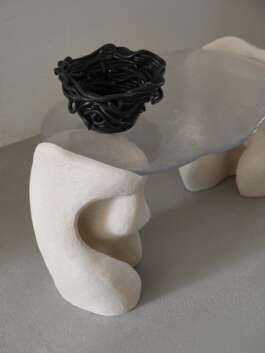
GL: One of the central pieces in my presentation is a table that brings together the two mineral materials currently shaping my practice: clay and glass. The table stands on two hand-built ceramic bases supporting a large cast glass surface, a floating plane resting on an earthy foundation. The glass appears almost like frozen ice, opaque yet softly translucent, with small air bubbles suspended inside. What fascinates me is that this seemingly frozen surface is actually shaped through intense heat during the casting process. Clay feels grounded and textured, while glass appears fluid and luminous. Bringing them together creates a dialogue between movement and stability, forming a surface that seems to hover lightly above its base.
C: Can you briefly describe your process?
GL: My process begins without a fixed idea. I start with an intention and allow the material to guide the form. Working with clay is a physical dialogue between my hands, my eye and the behaviour of the material. As I build a piece, I look for the point where everything comes into balance and it feels right to stop. Once the piece enters the kiln, part of the process is no longer in my control. Clay shrinks and surfaces shift. I see this unpredictability not as a flaw, but as the stage where the object finds its character.
C: What is your favourite material?
GL: What interests me most is not a single material, but the dialogue that emerges between them. Clay has been central to my practice for years because of its immediacy. It responds directly to the hand, and the firing process fixes a moment of movement within the material. More recently I began working with glass. Clay finds its form through intense heat, while glass settles into shape as it cools. Bringing these materials together allows me to explore their contrasts, the grounded tactility of clay and the fluid luminosity of glass.

© Gloria Landenberger, photo by Simone Frank

© Simone Frank
COLLECTIBLE In-Depth
Gloria Landenberger
March 2026
This series, COLLECTIBLE In-Depth, unveils the backstage of contemporary creation. Tackling various topics from personal designer processes to the position of collectible design on the global design market, COLLECTIBLE In-Depth offers different views to suit all tastes. Today we speak with Gloria Landenberger.
COLLECTIBLE: What does collectible design bring compared to more mass-produced objects?
Gloria Landenberger: Collectible design carries the trace of the moment it was made. In mass production, objects are designed to be identical. In collectible design, the process remains visible: materials shift, surfaces change, and small imperfections appear. These traces give each piece its own character. In my work with clay and glass, transformation plays an important role. Clay moves and shrinks in the heat of the kiln, while glass slowly settles into form as it cools. Sometimes the glass traps tiny air bubbles along the way like tiny accidents frozen inside the surface. These moments cannot be controlled, and that is precisely what allows an object to capture time.
C: Can you talk about a new piece or collection you are presenting at COLLECTIBLE this year?
GL: One of the central pieces in my presentation is a table that brings together the two mineral materials currently shaping my practice: clay and glass. The table stands on two hand-built ceramic bases supporting a large cast glass surface, a floating plane resting on an earthy foundation. The glass appears almost like frozen ice, opaque yet softly translucent, with small air bubbles suspended inside. What fascinates me is that this seemingly frozen surface is actually shaped through intense heat during the casting process. Clay feels grounded and textured, while glass appears fluid and luminous. Bringing them together creates a dialogue between movement and stability, forming a surface that seems to hover lightly above its base.
C: Can you briefly describe your process?
GL: My process begins without a fixed idea. I start with an intention and allow the material to guide the form. Working with clay is a physical dialogue between my hands, my eye and the behaviour of the material. As I build a piece, I look for the point where everything comes into balance and it feels right to stop. Once the piece enters the kiln, part of the process is no longer in my control. Clay shrinks and surfaces shift. I see this unpredictability not as a flaw, but as the stage where the object finds its character.
C: What is your favourite material?
GL: What interests me most is not a single material, but the dialogue that emerges between them. Clay has been central to my practice for years because of its immediacy. It responds directly to the hand, and the firing process fixes a moment of movement within the material. More recently I began working with glass. Clay finds its form through intense heat, while glass settles into shape as it cools. Bringing these materials together allows me to explore their contrasts, the grounded tactility of clay and the fluid luminosity of glass.

© Gloria Landenberger, photo by Simone Frank