© Giulia Cosenza & Salon Poisson
COLLECTIBLE In-Depth
Giulia Cosenza & Salon Poisson
March 2026
This series, COLLECTIBLE In-Depth, unveils the backstage of contemporary creation. Tackling various topics from personal designer processes to the position of collectible design on the global design market, COLLECTIBLE In-Depth offers different views to suit all tastes. Today we speak with Giulia Cosenza & Anne Bo Vis from Salon Poisson.
COLLECTIBLE: Can you talk about a new piece or collection you are presenting at COLLECTIBLE this year?
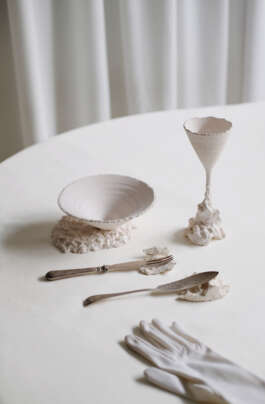
Giulia Cosenza & Salon Poisson: At COLLECTIBLE we present Encounters, a collaborative installation that reimagines the table as a site of exchange between materials, objects and temporalities. The project is a never seen before edition that will be unveiled for the very first time during Collectible. It brings together two typologies of hybrid objects: ceramic tableware and dining glasses combining clay and blown glass. Both rest on sculptural, rock-like bases made from reclaimed clay. Staged as a shared tablescape, the work explores tension between fragility and groundedness, tradition and experimentation, positioning the table as both landscape and stage for interaction.
C: Why do you focus on contemporary collectible design? What does it mean to you?
GC & SP: Collectible design allows us to work in a space where function, material research, and narrative can coexist without hierarchy. It offers the freedom to question everyday objects while still remaining connected to use and ritual. For us, contemporary collectible design is about creating pieces that sit between design and art—objects that invite reflection, emotional connection, and conversation, rather than providing immediate answers or purely functional solutions.
C: What is your favourite material?
GC & SP: Clay is central to this project. As mentioned earlier Encounters creates hybrid tableware objects that “rest on”/or “emerge from” sculptural, stone-like bases made from reclaimed clay sourced from failed prototypes and production remnants. Reworked into geological supports, this material grounds the objects while quietly embedding a process of reuse into the work’s material logic. Delicate, refined shapes rise from what is essentially artistic debris, creating tension between fragility and weight.
C: What are the key questions you ask yourself before starting to conceptualise a new piece?
GC & SP: We often begin by asking how an object will be encountered—materially, spatially, and socially. How will it be touched, seen, or shared? What references does it carry, and how can those be challenged? We also ask what materials are already present in our process, including remnants or leftovers, and how they can be reactivated meaningfully rather than discarded.
These questions guide the project from the inside out. They inform not only the object’s form, but its material choices, scale, and spatial presence. By thinking about encounter, reuse, and reference from the outset, the final narrative becomes embedded in the work rather than added afterward. The piece unfolds as an experience—one that is open-ended, relational, and shaped by how people move around and engage with it.
C: Where do you take your inspiration from?
GC & SP: The project draws from the history of tableware and domestic objects, particularly through Salon Poisson’s antiques collection and research into archetypical forms. These references act as a starting point rather than a model to reproduce. Familiar silhouettes are reinterpreted, distorted, and gently disrupted, creating objects that carry the “ghost” of traditional forms while shifting them into a contemporary language. The work becomes an encounter between materials and objects, between ancient and contemporary design, between what is designed and what is found—allowing different temporalities to coexist harmoniously.
C: Are you more result- or process-oriented?
GC & SP: We are strongly process-oriented. The final objects are important, but they emerge from experimentation, material testing, and exchange. Many of the project’s key decisions happen through making—working with what is already there, responding to imperfections, and allowing unexpected outcomes to shape the work. The result is a reflection of that process rather than a fixed, predetermined goal.
C: How do you question or challenge functionality in your design process?
GC & SP: We don’t reject functionality, but we deliberately place it in tension with other qualities such as material expression, instability, or spatial presence. In Encounters, objects remain usable, yet their weight, bases, or compositions slow down interaction. This pause invites awareness—of the object, the gesture, and the act of sharing—challenging habitual use without denying it.

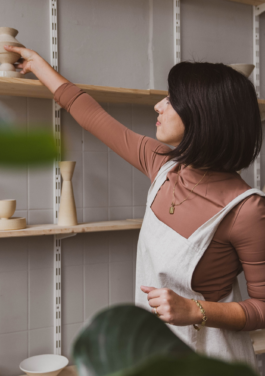
© Giulia Cosenza, photo by Laure van Rooij

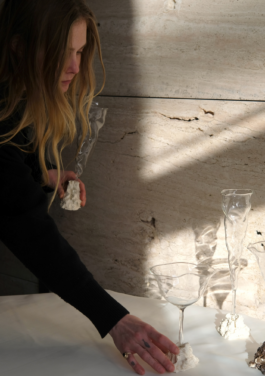
© Anne Bo Vis

© Giulia Cosenza & Salon Poisson
COLLECTIBLE In-Depth
Giulia Cosenza & Salon Poisson
March 2026
This series, COLLECTIBLE In-Depth, unveils the backstage of contemporary creation. Tackling various topics from personal designer processes to the position of collectible design on the global design market, COLLECTIBLE In-Depth offers different views to suit all tastes. Today we speak with Giulia Cosenza & Anne Bo Vis from Salon Poisson.
COLLECTIBLE: Can you talk about a new piece or collection you are presenting at COLLECTIBLE this year?
Giulia Cosenza & Salon Poisson: At COLLECTIBLE we present Encounters, a collaborative installation that reimagines the table as a site of exchange between materials, objects and temporalities. The project is a never seen before edition that will be unveiled for the very first time during Collectible. It brings together two typologies of hybrid objects: ceramic tableware and dining glasses combining clay and blown glass. Both rest on sculptural, rock-like bases made from reclaimed clay. Staged as a shared tablescape, the work explores tension between fragility and groundedness, tradition and experimentation, positioning the table as both landscape and stage for interaction.
C: Why do you focus on contemporary collectible design? What does it mean to you?
GC & SP: Collectible design allows us to work in a space where function, material research, and narrative can coexist without hierarchy. It offers the freedom to question everyday objects while still remaining connected to use and ritual. For us, contemporary collectible design is about creating pieces that sit between design and art—objects that invite reflection, emotional connection, and conversation, rather than providing immediate answers or purely functional solutions.
C: What is your favourite material?
GC & SP: Clay is central to this project. As mentioned earlier Encounters creates hybrid tableware objects that “rest on”/or “emerge from” sculptural, stone-like bases made from reclaimed clay sourced from failed prototypes and production remnants. Reworked into geological supports, this material grounds the objects while quietly embedding a process of reuse into the work’s material logic. Delicate, refined shapes rise from what is essentially artistic debris, creating tension between fragility and weight.
C: What are the key questions you ask yourself before starting to conceptualise a new piece?
GC & SP: We often begin by asking how an object will be encountered—materially, spatially, and socially. How will it be touched, seen, or shared? What references does it carry, and how can those be challenged? We also ask what materials are already present in our process, including remnants or leftovers, and how they can be reactivated meaningfully rather than discarded.
These questions guide the project from the inside out. They inform not only the object’s form, but its material choices, scale, and spatial presence. By thinking about encounter, reuse, and reference from the outset, the final narrative becomes embedded in the work rather than added afterward. The piece unfolds as an experience—one that is open-ended, relational, and shaped by how people move around and engage with it.
C: Where do you take your inspiration from?
GC & SP: The project draws from the history of tableware and domestic objects, particularly through Salon Poisson’s antiques collection and research into archetypical forms. These references act as a starting point rather than a model to reproduce. Familiar silhouettes are reinterpreted, distorted, and gently disrupted, creating objects that carry the “ghost” of traditional forms while shifting them into a contemporary language. The work becomes an encounter between materials and objects, between ancient and contemporary design, between what is designed and what is found—allowing different temporalities to coexist harmoniously.
C: Are you more result- or process-oriented?
GC & SP: We are strongly process-oriented. The final objects are important, but they emerge from experimentation, material testing, and exchange. Many of the project’s key decisions happen through making—working with what is already there, responding to imperfections, and allowing unexpected outcomes to shape the work. The result is a reflection of that process rather than a fixed, predetermined goal.
C: How do you question or challenge functionality in your design process?
GC & SP: We don’t reject functionality, but we deliberately place it in tension with other qualities such as material expression, instability, or spatial presence. In Encounters, objects remain usable, yet their weight, bases, or compositions slow down interaction. This pause invites awareness—of the object, the gesture, and the act of sharing—challenging habitual use without denying it.

© Giulia Cosenza, photo by Laure van Rooij

© Anne Bo Vis