
© Gab Bois
COLLECTIBLE In-Depth
Gab Bois
March 2026
This series, COLLECTIBLE In-Depth, unveils the backstage of contemporary creation. Tackling various topics from personal designer processes to the position of collectible design on the global design market, COLLECTIBLE In-Depth offers different views to suit all tastes. Today we speak with Gab Bois.
COLLECTIBLE: What advice would you give to someone starting a collection of contemporary design?
Gab Bois: Collect pieces that bring you joy. Not necessarily what you think you’ll appreciate the most, or what feels impressive. For me, if I’m going to live with something, it should move me somehow. In my experience, objects have their own way of carrying stories and legacy. I own pieces that were passed down from family members I never met, but I hold on to them because they feel like me. Other relatives chose different objects because they reflected them. We are only here for so long, and we never know who might stumble on our collections, and maybe even share our tastes and sensibilities when we’re gone.
C: How does the digital sphere influence your work? What is your relationship to 3D, AI, or other digital tools?
GB: It is such an interesting time to be answering this question, and I’m curious to see how things will have evolved in a couple months, let alone a year. The offer has never been louder and the demand is becoming more and more sceptical. I get tricked daily into thinking that products or objects I’m looking at are real just to realize I've been looking at a mock up or a render. I think 3D and AI can be used as tools. They can optimize time, help visualize ideas, and allow people to focus more on the parts of their work where they truly shine. Where it becomes complicated for me is when they’re used as a shortcut rather than a support. Having raging ADHD, my brain naturally gravitates toward the fastest, least painful way to complete a task, so it is a daily exercise of discipline to write that email, fill in that spreadsheet and so on. The question for me is always: is this enhancing the work, or is it replacing effort? However, I do feel very lucky because I’ve always been drawn to more analog and tangible processes in my own work, which don’t offer many avenues for shortcuts. All this to say that, just like most new things I think we will collectively have to find what that balance looks like in the future not only for us as individuals but as a whole, and mostly for our beloved planet.
C: Can you talk about a new piece or collection you are presenting at COLLECTIBLE this year?
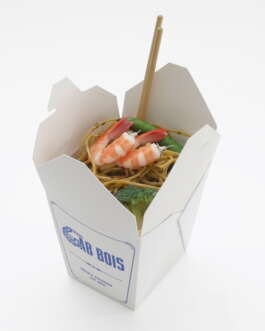
GB:This year, we’re presenting a table that looks good enough to eat, but nothing on it is actually edible. It’s a tablescape made up of trompe-l’œil food pieces pulled from our growing archive of objects. The studio has been building this language around food for years, freezing these very familiar moments in time, and this moment brings them together in a sculptural way. Everything looks recognizable but slightly off. Plates have bite marks in them. A cake is made entirely out of stacked ceramic plates. Some of the “food” pieces double as utensils. That tension between function and aesthetics has been a huge inspiration of mine since forever. In this collection, nothing is designed as it traditionally “should” be, but somehow the whole thing still functions in its own right.
C: How did you get into collectible design? Why did you focus your practice on this type of design rather than industrial design?
GB: I think I was born a collector. As a child, I’d collect rocks, shells, erasers, marbles, figurines, my favorite collection was my parent’s monthly bus passes, which all had a different designs. As an adult, I started collecting very random things I’d find at the thrift. For the last year, I’ve been accumulating objects that have “Je t’aime” written on them… it’s turned into a surprisingly large bunch. I’ve always loved objects, functional or not. I was a big stuffed animal kid, pouring emotion and intention into objects has always been a part of my life. That’s a big part of why I feel it makes so much sense and feels so aligned in my practice today.
C: Who has mentored or influenced your practice?
GB: My dad is just like me in relationship to objects. He is so generous with his time and his skills, he’ll make a custom tin for a relative’s favourite cookies, or a hand painted map of a friend’s newly acquired property. As a child, my dad would make me these absolutely larger than life toys, he once made me an igloo from a fridge box, each individual ice block carefully painted. or a corner store from another box, with a cut-out service window and a small bodega cat painted inside. He taught me you could make magic with things someone else might throw away. I owe a lot of my eye and my creative instincts to him.
© Gab Bois, photo by Alex Blouin and Jodi Heartz
© Gab Bois
COLLECTIBLE In-Depth
Gab Bois
March 2026
This series, COLLECTIBLE In-Depth, unveils the backstage of contemporary creation. Tackling various topics from personal designer processes to the position of collectible design on the global design market, COLLECTIBLE In-Depth offers different views to suit all tastes. Today we speak with Gab Bois.
COLLECTIBLE: What advice would you give to someone starting a collection of contemporary design?
Gab Bois: Collect pieces that bring you joy. Not necessarily what you think you’ll appreciate the most, or what feels impressive. For me, if I’m going to live with something, it should move me somehow. In my experience, objects have their own way of carrying stories and legacy. I own pieces that were passed down from family members I never met, but I hold on to them because they feel like me. Other relatives chose different objects because they reflected them. We are only here for so long, and we never know who might stumble on our collections, and maybe even share our tastes and sensibilities when we’re gone.
C: How does the digital sphere influence your work? What is your relationship to 3D, AI, or other digital tools?
GB: It is such an interesting time to be answering this question, and I’m curious to see how things will have evolved in a couple months, let alone a year. The offer has never been louder and the demand is becoming more and more sceptical. I get tricked daily into thinking that products or objects I’m looking at are real just to realize I've been looking at a mock up or a render. I think 3D and AI can be used as tools. They can optimize time, help visualize ideas, and allow people to focus more on the parts of their work where they truly shine. Where it becomes complicated for me is when they’re used as a shortcut rather than a support. Having raging ADHD, my brain naturally gravitates toward the fastest, least painful way to complete a task, so it is a daily exercise of discipline to write that email, fill in that spreadsheet and so on. The question for me is always: is this enhancing the work, or is it replacing effort? However, I do feel very lucky because I’ve always been drawn to more analog and tangible processes in my own work, which don’t offer many avenues for shortcuts. All this to say that, just like most new things I think we will collectively have to find what that balance looks like in the future not only for us as individuals but as a whole, and mostly for our beloved planet.
C: Can you talk about a new piece or collection you are presenting at COLLECTIBLE this year?
GB:This year, we’re presenting a table that looks good enough to eat, but nothing on it is actually edible. It’s a tablescape made up of trompe-l’œil food pieces pulled from our growing archive of objects. The studio has been building this language around food for years, freezing these very familiar moments in time, and this moment brings them together in a sculptural way. Everything looks recognizable but slightly off. Plates have bite marks in them. A cake is made entirely out of stacked ceramic plates. Some of the “food” pieces double as utensils. That tension between function and aesthetics has been a huge inspiration of mine since forever. In this collection, nothing is designed as it traditionally “should” be, but somehow the whole thing still functions in its own right.
C: How did you get into collectible design? Why did you focus your practice on this type of design rather than industrial design?
GB: I think I was born a collector. As a child, I’d collect rocks, shells, erasers, marbles, figurines, my favorite collection was my parent’s monthly bus passes, which all had a different designs. As an adult, I started collecting very random things I’d find at the thrift. For the last year, I’ve been accumulating objects that have “Je t’aime” written on them… it’s turned into a surprisingly large bunch. I’ve always loved objects, functional or not. I was a big stuffed animal kid, pouring emotion and intention into objects has always been a part of my life. That’s a big part of why I feel it makes so much sense and feels so aligned in my practice today.
C: Who has mentored or influenced your practice?
GB: My dad is just like me in relationship to objects. He is so generous with his time and his skills, he’ll make a custom tin for a relative’s favourite cookies, or a hand painted map of a friend’s newly acquired property. As a child, my dad would make me these absolutely larger than life toys, he once made me an igloo from a fridge box, each individual ice block carefully painted. or a corner store from another box, with a cut-out service window and a small bodega cat painted inside. He taught me you could make magic with things someone else might throw away. I owe a lot of my eye and my creative instincts to him.
© Gab Bois, photo by Alex Blouin and Jodi Heartz
