© FabBRICK
COLLECTIBLE In-Depth
FabBRICK
March 2026
This series, COLLECTIBLE In-Depth, unveils the backstage of contemporary creation. Tackling various topics from personal designer processes to the position of collectible design on the global design market, COLLECTIBLE In-Depth offers different views to suit all tastes. Today we speak with FabBRICK.
COLLECTIBLE: What does collectible design bring compared to more mass-produced objects?
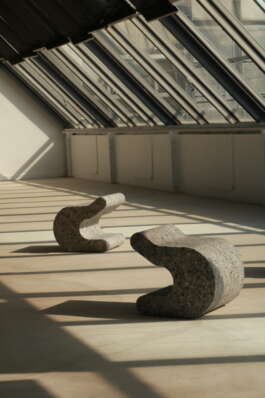
FabBRICK: For me, the contrast between collectible design and mass production is deeply personal. I launched my company seven years ago with a single product: a textile wall brick. As demand grew, I gradually expanded the workshop until it resembled a small factory. However, I lost some of my creativity and enjoyment along the way — it became too industrial and repetitive. That’s why I created a more collectible activity. Together with my team, I developed a rammed textile technique. It’s slow, experimental and intentionally limited. We produce fewer pieces, but we explore more. The focus shifts from scale to research, craftsmanship.
C: What is your favourite material?
F: I’ve worked exclusively with textiles for almost 10 years. Seven years ago, I invented a technique to transform them into a material that feels almost like stone. I thought I might quickly move on to other materials, but a decade later, I’m still fully immersed in textiles. There’s so much to explore, from the endless colour possibilities to the variety of textures and the many forms we can give them. Textiles continue to surprise and inspire me, pushing the boundaries of design, which is why they remain my favourite material.
C: Can you briefly describe your process?
F: My team of four and I work collaboratively. I start by proposing a broad artistic direction, and then we progressively refine our references, drawing inspiration from our surroundings, magazines, past collections, exhibitions and everyday details. The only rule I set is to never think about how we will manufacture the piece initially, so as not to limit the form. Once the mood board process is complete, we produce extensive drawings to exhaust the idea fully. After designing a piece or small collection, we create prototypes to validate feasibility and test different colourimetry and textile blends before finally moving into production in our workshop.
C: How does the digital sphere influence your work? What is your relationship to 3D, AI, or other digital tools?
F: My practice has progressively been shaped by digital tools. I started out in architecture school, drawing everything by hand, and then moved on to 3D software, which I immediately fell in love with. This enabled me to test ideas quickly, explore materials, experiment with textures and combinations, and visualise variations in real time. Today, I use 3D — and occasionally AI — wherever it helps me to think more deeply while saving time, especially in the early creative phases. It helps me to present ideas clearly to clients before production. Once validated, however, everything returns to hand in the workshop.

© FabBRICK

© FabBRICK
COLLECTIBLE In-Depth
FabBRICK
March 2026
This series, COLLECTIBLE In-Depth, unveils the backstage of contemporary creation. Tackling various topics from personal designer processes to the position of collectible design on the global design market, COLLECTIBLE In-Depth offers different views to suit all tastes. Today we speak with FabBRICK.
COLLECTIBLE: What does collectible design bring compared to more mass-produced objects?
FabBRICK: For me, the contrast between collectible design and mass production is deeply personal. I launched my company seven years ago with a single product: a textile wall brick. As demand grew, I gradually expanded the workshop until it resembled a small factory. However, I lost some of my creativity and enjoyment along the way — it became too industrial and repetitive. That’s why I created a more collectible activity. Together with my team, I developed a rammed textile technique. It’s slow, experimental and intentionally limited. We produce fewer pieces, but we explore more. The focus shifts from scale to research, craftsmanship.
C: What is your favourite material?
F: I’ve worked exclusively with textiles for almost 10 years. Seven years ago, I invented a technique to transform them into a material that feels almost like stone. I thought I might quickly move on to other materials, but a decade later, I’m still fully immersed in textiles. There’s so much to explore, from the endless colour possibilities to the variety of textures and the many forms we can give them. Textiles continue to surprise and inspire me, pushing the boundaries of design, which is why they remain my favourite material.
C: Can you briefly describe your process?
F: My team of four and I work collaboratively. I start by proposing a broad artistic direction, and then we progressively refine our references, drawing inspiration from our surroundings, magazines, past collections, exhibitions and everyday details. The only rule I set is to never think about how we will manufacture the piece initially, so as not to limit the form. Once the mood board process is complete, we produce extensive drawings to exhaust the idea fully. After designing a piece or small collection, we create prototypes to validate feasibility and test different colourimetry and textile blends before finally moving into production in our workshop.
C: How does the digital sphere influence your work? What is your relationship to 3D, AI, or other digital tools?
F: My practice has progressively been shaped by digital tools. I started out in architecture school, drawing everything by hand, and then moved on to 3D software, which I immediately fell in love with. This enabled me to test ideas quickly, explore materials, experiment with textures and combinations, and visualise variations in real time. Today, I use 3D — and occasionally AI — wherever it helps me to think more deeply while saving time, especially in the early creative phases. It helps me to present ideas clearly to clients before production. Once validated, however, everything returns to hand in the workshop.

© FabBRICK