© Renaat Nijs
COLLECTIBLE In-Depth
ÆTHER/MASS
March 2026
This series, COLLECTIBLE In-Depth, unveils the backstage of contemporary creation. Tackling various topics from personal designer processes to the position of collectible design on the global design market, COLLECTIBLE In-Depth offers different views to suit all tastes. Today we speak with ÆTHER/MASS.
COLLECTIBLE: What does collectible design bring compared to more mass-produced objects?
ÆTHER/MASS: Freedom. Before ÆTHER/MASS, I worked for many years as an industrial designer, creating mass-produced objects such as lamps, umbrellas, and watering cans. Although Goethe was right when he said, “In der Beschränkung zeigt sich erst der Meister” (“It is in self-limitation that a master first shows himself”), I ultimately found these constraints too restrictive. ÆTHER/MASS exists to create a world where I can freely express ideas without external limitations, serving as a platform for pure self-expression and uninhibited imagination, while acting as my own guide and critic.
C: How does the digital sphere influence your work? What is your relationship to 3D, AI, or other digital tools?
Æ: Unlike many designers working in collectible design, I am not a maker. I consider myself a conceptual designer, developing ideas through sketches and 2D and 3D software. I collaborate closely with artisans who translate these concepts, adding their material knowledge and craftsmanship. The most valuable stage is challenging one another before production begins. At this point, I believe AI is not truly creative; it recombines existing ideas found on the web and turns them into glossy, seductive, but ultimately meaningless forms.
C: Can you talk about a new piece or collection you are presenting at COLLECTIBLE this year?
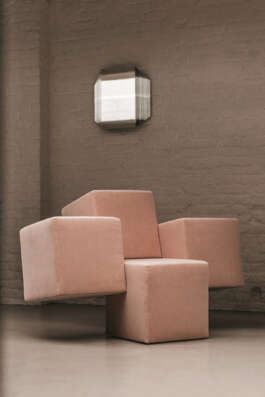
Æ: The most striking object in the new collection is the Cubist Chair, inspired by Cubism, the early 20th-century avant-garde movement that transformed visual art through abstraction and geometry. Cubism fragments and reassembles forms to show multiple perspectives simultaneously. The chair is composed of four identical cubes arranged into a collage that shifts visually depending on the viewing angle. Traditional elements are abstracted into sculptural forms, challenging conventional ideas of furniture. The piece was created in collaboration with Martijn Stelt.
C: What is your favourite material?
Æ: I love working with plain, everyday materials, using them in their purest, most solid form to highlight their inherent qualities. This approach is why I believe in making objects from a single material. The Strata Mirror exemplifies this philosophy. Crafted entirely from layered sheet glass, it uses the mirror’s own substance to form a self-contained, multifaceted frame. Extra-clear mirror glass gives the exposed edges an almost transparent appearance, creating a subtle tension between reflection and transparency. In this design, the mirror effectively frames itself, transforming a usually overlooked boundary into a central visual feature.

© Davy Grosemans, photo by Renaat Nijs

© Renaat Nijs
COLLECTIBLE In-Depth
ÆTHER/MASS
March 2026
This series, COLLECTIBLE In-Depth, unveils the backstage of contemporary creation. Tackling various topics from personal designer processes to the position of collectible design on the global design market, COLLECTIBLE In-Depth offers different views to suit all tastes. Today we speak with ÆTHER/MASS.
COLLECTIBLE: What does collectible design bring compared to more mass-produced objects?
ÆTHER/MASS: Freedom. Before ÆTHER/MASS, I worked for many years as an industrial designer, creating mass-produced objects such as lamps, umbrellas, and watering cans. Although Goethe was right when he said, “In der Beschränkung zeigt sich erst der Meister” (“It is in self-limitation that a master first shows himself”), I ultimately found these constraints too restrictive. ÆTHER/MASS exists to create a world where I can freely express ideas without external limitations, serving as a platform for pure self-expression and uninhibited imagination, while acting as my own guide and critic.
C: How does the digital sphere influence your work? What is your relationship to 3D, AI, or other digital tools?
Æ: Unlike many designers working in collectible design, I am not a maker. I consider myself a conceptual designer, developing ideas through sketches and 2D and 3D software. I collaborate closely with artisans who translate these concepts, adding their material knowledge and craftsmanship. The most valuable stage is challenging one another before production begins. At this point, I believe AI is not truly creative; it recombines existing ideas found on the web and turns them into glossy, seductive, but ultimately meaningless forms.
C: Can you talk about a new piece or collection you are presenting at COLLECTIBLE this year?
Æ: The most striking object in the new collection is the Cubist Chair, inspired by Cubism, the early 20th-century avant-garde movement that transformed visual art through abstraction and geometry. Cubism fragments and reassembles forms to show multiple perspectives simultaneously. The chair is composed of four identical cubes arranged into a collage that shifts visually depending on the viewing angle. Traditional elements are abstracted into sculptural forms, challenging conventional ideas of furniture. The piece was created in collaboration with Martijn Stelt.
C: What is your favourite material?
Æ: I love working with plain, everyday materials, using them in their purest, most solid form to highlight their inherent qualities. This approach is why I believe in making objects from a single material. The Strata Mirror exemplifies this philosophy. Crafted entirely from layered sheet glass, it uses the mirror’s own substance to form a self-contained, multifaceted frame. Extra-clear mirror glass gives the exposed edges an almost transparent appearance, creating a subtle tension between reflection and transparency. In this design, the mirror effectively frames itself, transforming a usually overlooked boundary into a central visual feature.

© Davy Grosemans, photo by Renaat Nijs