
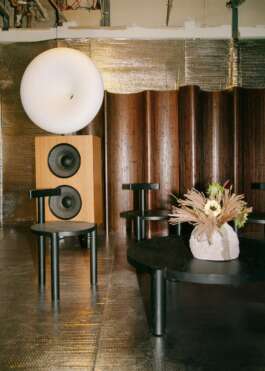

Talks Lounge at COLLECTIBLE New York 2026. Staging by ASH Staging / Room Service, sound by Silence Please, florals by @BUYTHEMFLOWERS. Image by Joe Tankersley.
COLLECTIBLE In-Depth
Ash Staging & Room Service
November 2026
This series, COLLECTIBLE In-Depth, unveils the backstage of contemporary creation. Tackling various topics from personal designer processes to the position of collectible design on the global design market, COLLECTIBLE In-Depth offers different views to suit all tastes. Today we speak with Andrew Bowen, Co-Founder and CEO of Room Service and Ash Staging, about furnishing the Talks Lounge at COLLECTIBLE New York 2026.
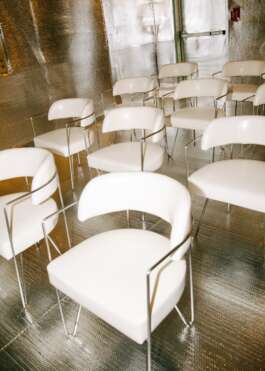
Talks Lounge at COLLECTIBLE New York 2026. Staging by ASH Staging / Room Service, sound by Silence Please. Image by Joe Tankersley.
COLLECTIBLE: Room Service was created in response to what you describe as a fragmented FF&E process, bringing design, procurement, manufacturing, installation, and project management under one roof. What did you see as the biggest opportunity to rethink the way fully furnished spaces are delivered?
Andrew Bowen: For us, the biggest opportunity we saw was to simplify a process that had become unnecessarily complex and fragmented. Furnishing a space, particularly at scale, has traditionally, for some time now, involved a tremendous number of independent parties, each operating in silos, and often with competing priorities. Designers who don’t procure. Storage experts who don’t install. (The list goes on.) The result is an experience that's expensive, time-consuming, and frequently frustrating for the client.
Given our experience over the past 15+ years creating thousands of spaces for our clients and even ourselves, we saw an opportunity to bring those disciplines together under one roof, creating a cohesive process from initial concept through to the last step of installation. Equally important was the opportunity to deliver exceptional design more efficiently.
I don't believe that exceptional, thoughtfully furnished spaces should require an extraordinary amount of time, money, or effort to realize. Room Service is really about closing that gap. Our mission statement is to simplify the complexity of furnishing spaces beautifully.
C: For COLLECTIBLE, Room Service is furnishing the Talks Lounge, which will host this year’s panel discussions. How did you approach creating a setting that feels elevated and distinctive while still supporting the practical needs of speakers and audiences?
AB: I think the best interiors often find the right balance between having a clear point of view and also feeling completely effortless to inhabit. For the Talks Lounge, we wanted to create something that felt considered and site-specific, but not overly designed or fussy. The furniture should be interesting in its own right without competing with the people occupying it.
There's also something very important about atmosphere in sparking good conversation. We wanted the setting to feel intimate and residential. Never institutional. The idea is that the speakers feel at ease, the audience is engaged, and the space has enough character to be memorable without becoming a distraction.
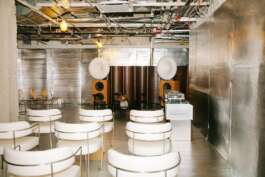
"We wanted the setting to feel intimate and residential. Never institutional."
C: When designing a space for live conversation, what do you think furniture can contribute beyond function?
AB: Furniture and decoration has, of course, an enormous influence on how people behave in a space. For those outside of our industry, this often happens without their realizing it. The scale, arrangement, and character of even just a few pieces can completely change the dynamic and end result.
I think there's a psychological dimension to furniture that's easy to overlook. A more relaxed, borderline residential arrangement can make a conversation feel less formal and more spontaneous. On the other hand, highly polished and structured commercial spaces immediately position us as our most serious selves – in a New York boardroom, for example, people are quite literally all buttoned up.
And of course, furniture and objects communicate a point of view. The objects we choose to surround ourselves with say everything about what we value, who we are, and how we inhabit our world. They become the world we invite others into. I think there’s enormous value in that.
C: How do you balance a strong curatorial point of view with the practical demands of comfort, sightlines, and repeated use throughout a program of talks?
AB: I suppose I don't really see those things as being in opposition. Good design can accommodate practical requirements without compromising its identity. In fact, I think constraints often make the outcome much more interesting.
We're always thinking about how a space will actually be used, not simply how it will photograph. Proportion, durability, and circulation are fundamental considerations, particularly in a setting that needs to accommodate many people and a program full of events.
Ultimately, the success of the space is measured by how well it works for the people using it.
One of our core values at the studio is Design with Purpose. For us, that means beyond just looking good, spaces we create must evoke emotion, solve problems, and achieve their objectives. We brought that mindset here, as we do with all of our work.

Talks Lounge at COLLECTIBLE New York 2026. Staging by ASH Staging / Room Service, sound by Silence Please, florals by @BUYTHEMFLOWERS. Image by Joe Tankersley.
C: What role does collectible or independently designed furniture play within your broader approach to interiors, if any? What can a distinctive object bring to a space that more conventional furnishing cannot?
AB: Even from a single digit age, I've always been drawn to furniture as a critical art form in its own right. It’s the one we arguably live closest to every day. I think the best pieces occupy an interstitial space between sculpture and utility, where something can be both attractive and fundamentally useful.
I'm particularly interested in objects that have a clear point of view, whether that's expressed through material, construction, or some other unexpected detail. Even one distinctive piece can give an otherwise relatively white box interior an entire identity.
That said, I don't think every object in a room needs to be extraordinary or unusual. In fact, I generally prefer when it isn't. There's something very compelling about experiencing the tension between exceptional, highly-specific pieces paired with more familiar staples. The contrast allows the rare objects to stand out, and makes the overall space feel more natural and less precious.
C: What interested you about bringing Room Service into the context of COLLECTIBLE, and how did the design focus of the fair shape your approach to the Talks Lounge?
AB: Since its beginning, I’ve always admired COLLECTIBLE's commitment to contemporary design and its ability to bring together the most important voices of our time in a way that feels both rigorous and genuinely exciting. As someone who cares deeply about original design, I think platforms like this are incredibly important.
What interested us about bringing Room Service into the fair was the opportunity to demonstrate that a commercially-minded furnishing business and a strong appreciation for collectible design aren't mutually exclusive. In fact, we believe they inform and strengthen one another.
The Talks Lounge felt like a particularly appropriate place to explore that relationship. It's a space dedicated mainly to the exchange of ideas that is surrounded by independent displays of bespoke objects that exhibit the most compelling thinking in today’s design world. We wanted our contribution to feel like a natural and useful extension of that environment, while letting the incredible work of those around us shine.
About Room Service & Andrew Bowen
From the mastermind hoteliers at Ash Hotels and the expert stagers at Ash Staging comes a new type of company, Room Service®, offering full-suite furnishing and interior decoration for the hospitality and commercial industries.
Andrew Bowen is a Partner of AD100 and Wallpaper* 400 firm Ash and Co-Founder and CEO of Room Service and Ash Staging. Ash is also featured in Phaidon’s By Design: The World’s Best Contemporary Interior Designers (2021) as one of the top 100 design firms in the world.
He has completed over 1,500 projects across the country over the past 15 years, representing over $50 billion in real estate in the company’s key markets, which include New York, Los Angeles, the Hamptons, Aspen, San Francisco, Seattle, Chicago, Boston, Washington D.C., and southern Florida. The firm is currently managing hundreds of projects annually.
Andrew is a Guest Lecturer at the School of Architecture of Yale University. He is a Member of the Urban Land Institute (ULI), the American Society of Interior Designers (ASID), the National LGBT Chamber of Commerce (NGLCC), and the Real Estate Staging Association (RESA®).
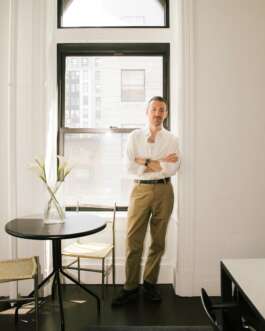
Andrew Bowen. © Joe Tankersley

Talks Lounge at COLLECTIBLE New York 2026. Staging by ASH Staging / Room Service, sound by Silence Please, florals by @BUYTHEMFLOWERS. Image by Joe Tankersley.
COLLECTIBLE In-Depth
Ash Staging & Room Service
November 2026
This series, COLLECTIBLE In-Depth, unveils the backstage of contemporary creation. Tackling various topics from personal designer processes to the position of collectible design on the global design market, COLLECTIBLE In-Depth offers different views to suit all tastes. Today we speak with Andrew Bowen, Co-Founder and CEO of Room Service and Ash Staging, about furnishing the Talks Lounge at COLLECTIBLE New York 2026.

Talks Lounge at COLLECTIBLE New York 2026. Staging by ASH Staging / Room Service, sound by Silence Please. Image by Joe Tankersley.
COLLECTIBLE: Room Service was created in response to what you describe as a fragmented FF&E process, bringing design, procurement, manufacturing, installation, and project management under one roof. What did you see as the biggest opportunity to rethink the way fully furnished spaces are delivered?
Andrew Bowen: For us, the biggest opportunity we saw was to simplify a process that had become unnecessarily complex and fragmented. Furnishing a space, particularly at scale, has traditionally, for some time now, involved a tremendous number of independent parties, each operating in silos, and often with competing priorities. Designers who don’t procure. Storage experts who don’t install. (The list goes on.) The result is an experience that's expensive, time-consuming, and frequently frustrating for the client.
Given our experience over the past 15+ years creating thousands of spaces for our clients and even ourselves, we saw an opportunity to bring those disciplines together under one roof, creating a cohesive process from initial concept through to the last step of installation. Equally important was the opportunity to deliver exceptional design more efficiently.
I don't believe that exceptional, thoughtfully furnished spaces should require an extraordinary amount of time, money, or effort to realize. Room Service is really about closing that gap. Our mission statement is to simplify the complexity of furnishing spaces beautifully.
C: For COLLECTIBLE, Room Service is furnishing the Talks Lounge, which will host this year’s panel discussions. How did you approach creating a setting that feels elevated and distinctive while still supporting the practical needs of speakers and audiences?
AB: I think the best interiors often find the right balance between having a clear point of view and also feeling completely effortless to inhabit. For the Talks Lounge, we wanted to create something that felt considered and site-specific, but not overly designed or fussy. The furniture should be interesting in its own right without competing with the people occupying it.
There's also something very important about atmosphere in sparking good conversation. We wanted the setting to feel intimate and residential. Never institutional. The idea is that the speakers feel at ease, the audience is engaged, and the space has enough character to be memorable without becoming a distraction.
"We wanted the setting to feel intimate and residential. Never institutional."
C: When designing a space for live conversation, what do you think furniture can contribute beyond function?
AB: Furniture and decoration has, of course, an enormous influence on how people behave in a space. For those outside of our industry, this often happens without their realizing it. The scale, arrangement, and character of even just a few pieces can completely change the dynamic and end result.
I think there's a psychological dimension to furniture that's easy to overlook. A more relaxed, borderline residential arrangement can make a conversation feel less formal and more spontaneous. On the other hand, highly polished and structured commercial spaces immediately position us as our most serious selves – in a New York boardroom, for example, people are quite literally all buttoned up.
And of course, furniture and objects communicate a point of view. The objects we choose to surround ourselves with say everything about what we value, who we are, and how we inhabit our world. They become the world we invite others into. I think there’s enormous value in that.
C: How do you balance a strong curatorial point of view with the practical demands of comfort, sightlines, and repeated use throughout a program of talks?
AB: I suppose I don't really see those things as being in opposition. Good design can accommodate practical requirements without compromising its identity. In fact, I think constraints often make the outcome much more interesting.
We're always thinking about how a space will actually be used, not simply how it will photograph. Proportion, durability, and circulation are fundamental considerations, particularly in a setting that needs to accommodate many people and a program full of events.
Ultimately, the success of the space is measured by how well it works for the people using it.
One of our core values at the studio is Design with Purpose. For us, that means beyond just looking good, spaces we create must evoke emotion, solve problems, and achieve their objectives. We brought that mindset here, as we do with all of our work.

Talks Lounge at COLLECTIBLE New York 2026. Staging by ASH Staging / Room Service, sound by Silence Please, florals by @BUYTHEMFLOWERS. Image by Joe Tankersley.
C: What role does collectible or independently designed furniture play within your broader approach to interiors, if any? What can a distinctive object bring to a space that more conventional furnishing cannot?
AB: Even from a single digit age, I've always been drawn to furniture as a critical art form in its own right. It’s the one we arguably live closest to every day. I think the best pieces occupy an interstitial space between sculpture and utility, where something can be both attractive and fundamentally useful.
I'm particularly interested in objects that have a clear point of view, whether that's expressed through material, construction, or some other unexpected detail. Even one distinctive piece can give an otherwise relatively white box interior an entire identity.
That said, I don't think every object in a room needs to be extraordinary or unusual. In fact, I generally prefer when it isn't. There's something very compelling about experiencing the tension between exceptional, highly-specific pieces paired with more familiar staples. The contrast allows the rare objects to stand out, and makes the overall space feel more natural and less precious.
C: What interested you about bringing Room Service into the context of COLLECTIBLE, and how did the design focus of the fair shape your approach to the Talks Lounge?
AB: Since its beginning, I’ve always admired COLLECTIBLE's commitment to contemporary design and its ability to bring together the most important voices of our time in a way that feels both rigorous and genuinely exciting. As someone who cares deeply about original design, I think platforms like this are incredibly important.
What interested us about bringing Room Service into the fair was the opportunity to demonstrate that a commercially-minded furnishing business and a strong appreciation for collectible design aren't mutually exclusive. In fact, we believe they inform and strengthen one another.
The Talks Lounge felt like a particularly appropriate place to explore that relationship. It's a space dedicated mainly to the exchange of ideas that is surrounded by independent displays of bespoke objects that exhibit the most compelling thinking in today’s design world. We wanted our contribution to feel like a natural and useful extension of that environment, while letting the incredible work of those around us shine.
About Room Service & Andrew Bowen
From the mastermind hoteliers at Ash Hotels and the expert stagers at Ash Staging comes a new type of company, Room Service®, offering full-suite furnishing and interior decoration for the hospitality and commercial industries.
Andrew Bowen is a Partner of AD100 and Wallpaper* 400 firm Ash and Co-Founder and CEO of Room Service and Ash Staging. Ash is also featured in Phaidon’s By Design: The World’s Best Contemporary Interior Designers (2021) as one of the top 100 design firms in the world.
He has completed over 1,500 projects across the country over the past 15 years, representing over $50 billion in real estate in the company’s key markets, which include New York, Los Angeles, the Hamptons, Aspen, San Francisco, Seattle, Chicago, Boston, Washington D.C., and southern Florida. The firm is currently managing hundreds of projects annually.
Andrew is a Guest Lecturer at the School of Architecture of Yale University. He is a Member of the Urban Land Institute (ULI), the American Society of Interior Designers (ASID), the National LGBT Chamber of Commerce (NGLCC), and the Real Estate Staging Association (RESA®).

Andrew Bowen. © Joe Tankersley