
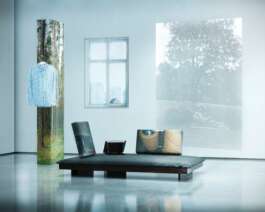

William Beck, Love Seat Diptych, Island, 2026. © Oleh Motorin
COLLECTIBLE In-Depth
William Beck
November 2026
This series, COLLECTIBLE In-Depth, unveils the backstage of contemporary creation. Tackling various topics from personal designer processes to the position of collectible design on the global design market, COLLECTIBLE In-Depth offers different views to suit all tastes. Today we speak with William Beck.
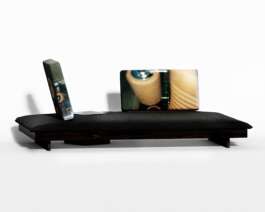
William Beck, Love Seat Diptych, Island, 2026. © Oleh Motorin
COLLECTIBLE: Can you talk about a new piece or collection you are presenting at COLLECTIBLE New York this year?
William Beck: The two seats are contrasting propositions doing the same thing. Island is a low wooden platform, open on all sides, with two backrests that let people decide how near they want to be. A hatch in its surface keeps things out of sight. Raft is a fiberglass shell on slender steel legs, lined with a quilt. Sit any way you like. Alongside them, They tell me to spend more time in nature, is a very useful “column” printed with my photograph of a pine plantation outside Berlin. It’s the piece of scenery that followed the furniture out of the renderings.
C: How do you navigate the relationship between experimentation and functionality?
WB: Treating function as a material is one of the most exciting parts of what I do. Furniture gives small commands all day long. Where you sit, which way you face, where your things go, where your eyes land in a room. I like loosening those instructions without stripping away usefulness. I’m especially interested in tuning friction, how much a thing insists versus how quietly it disappears. That said, what I make has to work, dependably, as intended. That’s the Kentucky in me. I ask a lot of objects.
C: How do materials shape the direction of your work?
WB: For me, a drawing is only where design begins. These pieces are definitely diagram-heavy, so I looked to materials to make forms that might seem obtuse feel familiar and approachable. I wanted the materials to carry ideas further, enriching the diagram with narrative rather than simply illustrating it. I pull from very different parts of my life, furniture making, building culture, digital media, and clothing, my most familiar lens on fabric. The ideas could survive in other materials. But through obsessive testing and experimenting, each has arrived somewhere so specific that I can’t imagine it made any other way.
"Of course I don’t have love figured out, so I made two."
C: Is there a material, technique, or way of working that you think deserves more attention?
WB: I think too much about how we metabolize design media today, and how easily images flatten into one-liners. Little depth. I’m interested in the slippage between object as image and image as object. I like the idea of living intimately with art, and furniture can be an exciting host for that. In these works, a photograph moves between registers, at times a familiar reference and at others an abstract texture that sinks into the object. Upcycling some beautiful tapestry could work too, only I’d feel like an impostor, so the photographs are my own.
C: Beyond rarity or edition size, what gives a design object lasting value for a collector?
WB: An object should still be interesting once the novelty of seeing it has worn off. I don’t mean that it should demand attention every day; the opposite. It should be able to settle into a room, absorb use, and become more particular to the people who live with it. I appreciate materials that age productively and carry evidence of being handled. Rarity alone doesn’t make for an interesting relationship. Ideally a collectible work remains a very good thing to live with.
C: Why did you make two love seats instead of one?
WB: Stanley Kubrick’s photograph of a couple riding the New York subway struck me as one of the most sincere yet subtle depictions of love I’ve ever seen. Designing one interpretation of the love seat felt too certain. Of course I don’t have love figured out, so I made two. Now they’re discussing my questions about how we organize ourselves and our things, how we occupy and relate to our spaces, about boundaries, closeness, usefulness, lightness, and intimacy. Those questions belong to furniture as much as they do to love. On the subject of love, who knows. As seats, they work.
About William Beck
William Beck is a designer whose furniture draws on furniture making, building culture, digital media and clothing.
For COLLECTIBLE New York 2026, Beck presents Love Seat Network: Island, a low wooden platform with two movable backrests, and Raft, a quilt-lined fiberglass shell on slender steel legs, alongside They tell me to spend more time in nature, a column printed with his photograph of a pine plantation outside Berlin.
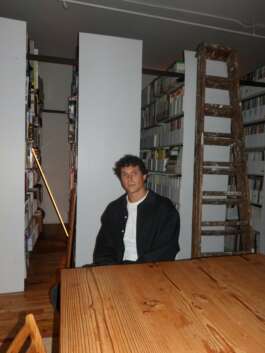
William Beck.

William Beck, Love Seat Diptych, Island, 2026. © Oleh Motorin
COLLECTIBLE In-Depth
William Beck
November 2026
This series, COLLECTIBLE In-Depth, unveils the backstage of contemporary creation. Tackling various topics from personal designer processes to the position of collectible design on the global design market, COLLECTIBLE In-Depth offers different views to suit all tastes. Today we speak with William Beck.

William Beck, Love Seat Diptych, Island, 2026. © Oleh Motorin
COLLECTIBLE: Can you talk about a new piece or collection you are presenting at COLLECTIBLE New York this year?
William Beck: The two seats are contrasting propositions doing the same thing. Island is a low wooden platform, open on all sides, with two backrests that let people decide how near they want to be. A hatch in its surface keeps things out of sight. Raft is a fiberglass shell on slender steel legs, lined with a quilt. Sit any way you like. Alongside them, They tell me to spend more time in nature, is a very useful “column” printed with my photograph of a pine plantation outside Berlin. It’s the piece of scenery that followed the furniture out of the renderings.
C: How do you navigate the relationship between experimentation and functionality?
WB: Treating function as a material is one of the most exciting parts of what I do. Furniture gives small commands all day long. Where you sit, which way you face, where your things go, where your eyes land in a room. I like loosening those instructions without stripping away usefulness. I’m especially interested in tuning friction, how much a thing insists versus how quietly it disappears. That said, what I make has to work, dependably, as intended. That’s the Kentucky in me. I ask a lot of objects.
C: How do materials shape the direction of your work?
WB: For me, a drawing is only where design begins. These pieces are definitely diagram-heavy, so I looked to materials to make forms that might seem obtuse feel familiar and approachable. I wanted the materials to carry ideas further, enriching the diagram with narrative rather than simply illustrating it. I pull from very different parts of my life, furniture making, building culture, digital media, and clothing, my most familiar lens on fabric. The ideas could survive in other materials. But through obsessive testing and experimenting, each has arrived somewhere so specific that I can’t imagine it made any other way.
"Of course I don’t have love figured out, so I made two."
C: Is there a material, technique, or way of working that you think deserves more attention?
WB: I think too much about how we metabolize design media today, and how easily images flatten into one-liners. Little depth. I’m interested in the slippage between object as image and image as object. I like the idea of living intimately with art, and furniture can be an exciting host for that. In these works, a photograph moves between registers, at times a familiar reference and at others an abstract texture that sinks into the object. Upcycling some beautiful tapestry could work too, only I’d feel like an impostor, so the photographs are my own.
C: Beyond rarity or edition size, what gives a design object lasting value for a collector?
WB: An object should still be interesting once the novelty of seeing it has worn off. I don’t mean that it should demand attention every day; the opposite. It should be able to settle into a room, absorb use, and become more particular to the people who live with it. I appreciate materials that age productively and carry evidence of being handled. Rarity alone doesn’t make for an interesting relationship. Ideally a collectible work remains a very good thing to live with.
C: Why did you make two love seats instead of one?
WB: Stanley Kubrick’s photograph of a couple riding the New York subway struck me as one of the most sincere yet subtle depictions of love I’ve ever seen. Designing one interpretation of the love seat felt too certain. Of course I don’t have love figured out, so I made two. Now they’re discussing my questions about how we organize ourselves and our things, how we occupy and relate to our spaces, about boundaries, closeness, usefulness, lightness, and intimacy. Those questions belong to furniture as much as they do to love. On the subject of love, who knows. As seats, they work.
About William Beck
William Beck is a designer whose furniture draws on furniture making, building culture, digital media and clothing.
For COLLECTIBLE New York 2026, Beck presents Love Seat Network: Island, a low wooden platform with two movable backrests, and Raft, a quilt-lined fiberglass shell on slender steel legs, alongside They tell me to spend more time in nature, a column printed with his photograph of a pine plantation outside Berlin.

William Beck.