
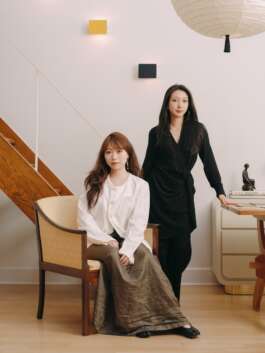
Uki Cao (left) and Maggie Pei (right). © David Luo
COLLECTIBLE In-Depth
iitem studio x M. Pei Studio
October 2026
COLLECTIBLE In-Depth goes behind the scenes of contemporary creation. From the private processes of individual designers to the place of collectible design in the global market, each conversation offers a different way into the field. Today we speak with Uki Cao of iitem studio and Maggie Pei of M. Pei Studio.
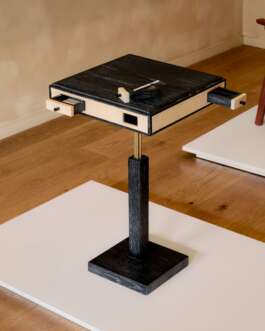
Maggie Pei, Scent Table, 2026. Ash, parchment and brass, 15½" L × 15½" W × 27¾" H. © Ben de Haan
"I hope visitors experience The Interlude Room as a miniature world that can transport them to a fictional, dreamy narrative."
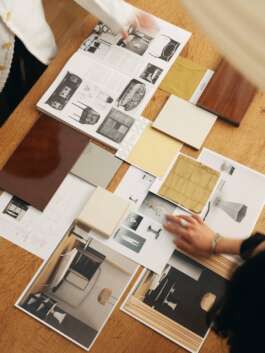
iitem studio. © David Luo
COLLECTIBLE: How did you get into contemporary collectible design? What drew you to this way of working?
Uki Cao: I studied Industrial Design at Pratt Institute and spent seven years designing furniture and products before founding iitem studio in 2022. My move into interior design came from a growing curiosity about how objects interact with architecture, atmosphere, and our daily lives. Returning to furniture and product design feels natural to me. Collectible design gives me the freedom to explore ideas that are completely my own, and at times they may not fit within the constraints of a client project at hand in my interiors practice. Collectible design is a personal expression and channel for me.
C: What makes a design collectible in your eyes?
UC: I don’t think collectibility is defined only by rarity or edition size. For me, a collectible object has a distinct character and a meaning, especially to its designer and maker, to exist beyond its immediate function. I’m drawn to pieces that allow us to learn how the designer might be able to see something differently and thus translate that into a complete novelty, whether that’s through an unexpected approach towards proportionality, or a particular material combination, or a familiar detail interpreted completely anew.
I also believe a collectible design object should continue to feel relevant or honest, even if its surroundings change. I believe the most interesting pieces can be placed within various interiors, contexts, and environments. They are able to stand alone but also relate with the variables around them, gradually gathering memories and personal meaning through everyday life.
C: When designing an object, how much do you imagine the space or context in which it will eventually live?
UC: I see space and context as interdependent to my design of the object. At iitem studio, my approach to design is rooted in the relationship itself (between objects and interiors) and how they can continuously shape and influence one another, as if it were a dialogue. I rarely see furniture or objects as isolated pieces. I’m interested in how their proportions, materials, and presence can completely shift or influence the atmosphere of a room. This is the exact reason why I am so thrilled to have the opportunity at COLLECTIBLE New York this year to create both the interiors and debut my first signature furniture and lighting collection. “The Interlude Room” is about that exchange of personal expression between the two realms.
In terms of the sequencing of design between interiors and product, sometimes I begin with a particular spatial moment, such as a bedside light, a screen in a dressing room, or a daybed placed at the center of a space. At the same time, I don’t want an object to belong to only one interior. I want each piece to have enough character to stand on its own so it can be somewhat universal, remaining open to different surroundings.
C: Can you briefly describe your process, from the first idea to the finished object?
UC: My process often begins with a small observation rather than a complete form. I keep a visual archive of details from fashion, sculpture, performances, interiors, and everyday objects in my studio. They are like glimpses; certain gestures or mechanisms will stay with me, visually, and they gradually find their way into a design. For example, my concept for the Kou Lighting Series, shown in the Interlude Room, began with my recollection of gestures that happen when someone opens and fastens a traditional Chinese pankou. Once the reference is integrated into the function of the object, I explore its possibilities through proportion, structure, materials, and the fabrication process.
C: Can you talk about a new piece or collection you are presenting at COLLECTIBLE New York this year?
UC: At COLLECTIBLE New York 2026, I will present my debut furniture and lighting collection, iitem Collection I by Uki Cao, within an imagined interior titled “The Interlude Room”. The collection draws inspiration from the romance, intimacy, and theatricality of 1920s interiors, combined with my personal archive of details, gestures, forms, and memories gathered over the years now crystallized.
iitem Collection I by Uki Cao includes the pankou-inspired Kou Lighting Series, the Octa Pendant, the Charm Mirror Screen with interchangeable charms, and the Unfurling Daybed, co-designed with Maggie Pei. The presentation also features M. Pei Studio’s Scent Table and Portière Shelf, alongside smaller objects iitem studio designed for ABOAB, including a wine bucket, candleholders, and trays.
C: What would you like visitors to understand after encountering your work at the fair?
UC: I hope visitors experience The Interlude Room as a miniature world that can transport them to a fictional, dreamy narrative, rather than an interior that frames and holds objects. I began with the idea of a fantasy represented in a room, imagining an atmosphere and feeling, the individual who might inhabit it, what they look like and what they are interested in, thinking of the small rituals they might do there or enjoy. The furniture, lighting, and objects gradually emerged from this world, each with their own character and purpose.
This process is how I approach design on the spectrum of product to interior, and with most prompts and contexts in mind. An interior can inspire an object, just as an object can shape an interior. Their influence and hold over each other carries equal weight. I hope visitors will feel a sense of intimacy, and feel inspired to explore and get curious about the details within “The Interlude Room”.
About iitem studio & M. Pei Studio
Founded by New York-based designer Uki Cao, iitem studio is an interior and furniture design practice shaped by Cao’s personal and atmospheric approach to design. Her work imagines the home as a place where memories, emotions, and traces of everyday life quietly gather. Through interiors, furniture, objects, and collections, Cao creates spaces that reflect the people who inhabit them and the stories they carry, shaping a sense of home that feels intimate, romantic, and distinctly their own.
M. Pei Studio is a New York-based furniture design practice founded by Maggie Pei. Rooted in an appreciation for objects and the narratives they carry, the studio explores their hidden beauty through material and form, creating a dialogue between past and present.

Uki Cao & Maggie Pei, Unfurling Daybed, 2026. Dedar moiré silk, CCMOLTEN pleated silk, parchment-clad base, nickel-plated cast iron legs and buttons, 78" × 20" × 18". © iitem studio
Uki Cao (left) and Maggie Pei (right). © David Luo
Maggie Pei, Scent Table, 2026. Ash, parchment and brass, 15½" L × 15½" W × 27¾" H. © Ben de Haan
"I hope visitors experience The Interlude Room as a miniature world that can transport them to a fictional, dreamy narrative."
iitem studio. © David Luo
Uki Cao & Maggie Pei, Unfurling Daybed, 2026. Dedar moiré silk, CCMOLTEN pleated silk, parchment-clad base, nickel-plated cast iron legs and buttons, 78" × 20" × 18". © iitem studio
