
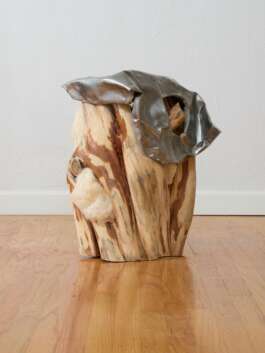
Nikhil Y Sharma, Untitled Night Stand, 2026. © David Coe
COLLECTIBLE In-Depth
Tanuvi Hegde & Nikhil Y Sharma
October 2026
COLLECTIBLE In-Depth goes behind the scenes of contemporary creation. From the private processes of individual designers to the place of collectible design in the global market, each conversation offers a different way into the field. Today we speak with Tanuvi Hegde and Nikhil Y Sharma.
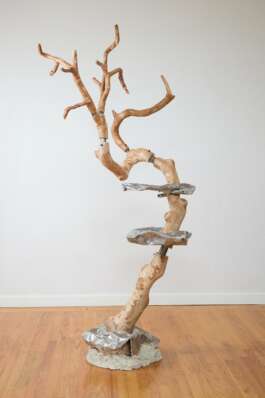
Nikhil Y Sharma, Untitled Coat Rack, 2026. Rescued camphor wood, steel, concrete, 90" × 38" × 25". © David Coe
"I hope my work makes you think twice about cutting down a tree."
— Nikhil Y Sharma
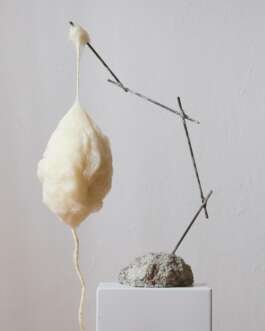
Nikhil Y Sharma, Untitled Table Lamp, 2026. Sheep wool, steel, concrete, 25" × 16" × 9". © David Coe
COLLECTIBLE: How did you first find your way into the field?
Nikhil Y Sharma: I grew up in the Silicon Valley dreaming about being like Steve Jobs and starting a company in my parent’s garage. But by the time I got my first job at a startup, that dream disappeared and I found myself disillusioned. As a means of self-preservation, I channeled the love I had for building in the virtual world into the physical and began woodworking. As my practice matured, collectible design became a way for me to share the story of how I fell in love with my natural surroundings and the things that stood in my way.
Tanuvi Hegde: I started out in architecture, moved into interior design, and eventually found my way to furniture design. With each shift, I kept moving towards a smaller scale and a more direct relationship with the things people interact with. I also found myself wanting to understand the process of making and understanding materials not just by how they look, but by how they feel, behave, and respond to being worked. Through furniture design, I was able to experiment with different materials, learn through making, and create objects that shape the environment we live in.
C: Why do you focus on contemporary collectible design? What does it mean to you?
NYS: I grew up in an environment that made it seem like there was a right way to live a life. The structure of my engineering education continued to reinforce that belief. My practice was formed as a way to escape from this rigidity. I chose not to seek formal training, but instead created my own processes that embraced the natural beauty of imperfection. Contemporary collectible design wasn’t something I knew about when I began making. But because of my focus on process, material and story it became the place that best supported my practice.
C: What are the key questions you ask yourself before beginning a new piece?
TH: I let curiosity lead the way. I ask myself what I want to explore, whether it’s a material, a process, or a relationship between an object and the person interacting with it. I’m interested in what happens when I push beyond the obvious use of a material or object. I don’t always know what the final piece will look like when I start, and I enjoy allowing experimentation and the process of making to shape where the work goes.
C: How do you navigate the relationship between experimentation and functionality?
TH: My background in architecture has taught me to think about function and how an object exists within a space. But I don’t see experimentation and functionality as opposing forces. I like to push the boundaries of what an object can be while remaining conscious of how people might interact with it. Sometimes, functionality drives the form, other times, an idea or material leads the way, and function becomes part of the process of figuring out the piece. It’s about finding a balance that allows the object to be both considered and unexpected.
C: Can you talk about a new piece or collection you are presenting at COLLECTIBLE New York this year?
NYS: The pieces I’m bringing to COLLECTIBLE are part of a larger collection called “i like trees now”. Even though I grew up surrounded by countless oak trees and lush rolling hills, I never allowed myself to be immersed in them. Primarily focused on career, I wasn’t able to appreciate what was slowly changing around me. My series blends industrial materials with rescued wood from the changing urban forest around me. The resulting pieces exist between the physical and industrial and natural worlds, embodying the tension that’s created when rigidity is imposed upon the natural way of being.
TH: I’m presenting a chair and a pair of sculptural mirrors that explore belonging and the experience of finding one’s place in an unfamiliar environment. The chair features a vine woven around an American oak frame, taking the form of an abstract female figure. The mirrors extend this idea, using carved, tree-like wooden forms to frame two different views of the person standing before them. Together, the pieces explore how we make space for ourselves in the world and come to see ourselves within it.
C: What would you like visitors to understand after encountering your work at the fair?
NYS: My mom’s neighbors had this oak tree that was the tallest tree in the neighborhood. Every time I visited home I would take a walk and admire it. In a way that tree became my friend. It was part of what I loved most about coming home. One day we got new neighbors, and a year later that oak tree was gone. It wasn’t dying, it wasn’t a danger. The neighbors just didn’t like the leaves. Two more years went by, and they moved out. I hope my work makes you think twice about cutting down a tree.
About Tanuvi Hegde & Nikhil Y Sharma
Nikhil Y Sharma and Tanuvi Hegde present “I Wish I Could Quit My Job”, a body of work that explores how immigration to America has shaped their perspectives and practices. The title reflects a broader desire to step outside of inherited expectations and prescribed ideas of success.
Born and raised in the Silicon Valley, Nikhil Y Sharma started his career as an engineer before returning to woodworking as a means of self-preservation. His work explores the inherent conflict between our natural and industrial worlds and how that tension also plays out in our internal landscapes, blending reclaimed wood and sheep wool with industrial building materials. He works between his studio in New York City and his dad’s garage in the Silicon Valley.
Tanuvi Hegde is an Indian designer and maker based in Brooklyn, New York. Her work explores the relationship between humans, materials and the environments they inhabit. Working primarily through furniture and objects, her practice considers how sensory experiences can shape our relationship with the things around us. This collection marks a shift towards the sculptural, informed by her experience of building a life in America.
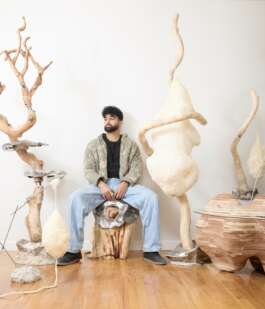
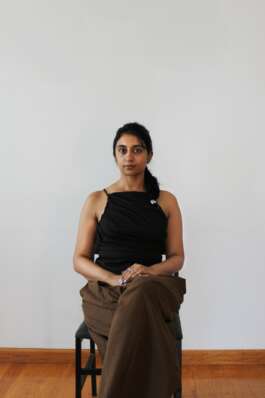
Nikhil Y Sharma. © David Coe
Tanuvi Hegde. © Sagarika Konanuru
Nikhil Y Sharma, Untitled Night Stand, 2026. © David Coe
Nikhil Y Sharma, Untitled Coat Rack, 2026. Rescued camphor wood, steel, concrete, 90" × 38" × 25". © David Coe
"I hope my work makes you think twice about cutting down a tree."
— Nikhil Y Sharma
Nikhil Y Sharma, Untitled Table Lamp, 2026. Sheep wool, steel, concrete, 25" × 16" × 9". © David Coe
Nikhil Y Sharma. © David Coe
Tanuvi Hegde. © Sagarika Konanuru
