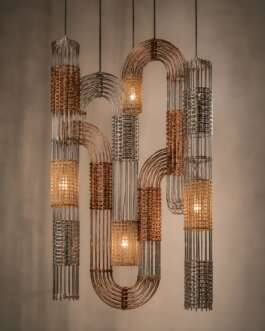
Upasana Jain, INTERLACE Sculptural Lighting, 2026. Stainless steel, cane and copper, 1200 × 800 mm. © Artisanal Abode
COLLECTIBLE In-Depth
Artisanal Abode
October 2026
COLLECTIBLE In-Depth goes behind the scenes of contemporary creation. From the private processes of individual designers to the place of collectible design in the global market, each conversation offers a different way into the field. Today we speak with Upasana Jain of Artisanal Abode.
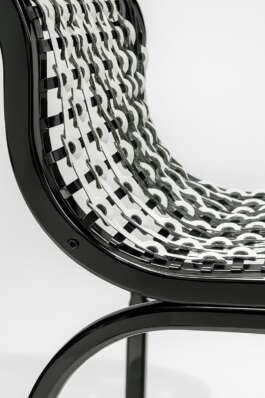
Artisanal Abode, Craft Nouveau Bench (detail). © Artisanal Abode
"There is something compelling about an object that appears effortless or even improbable, yet performs its function with precision."
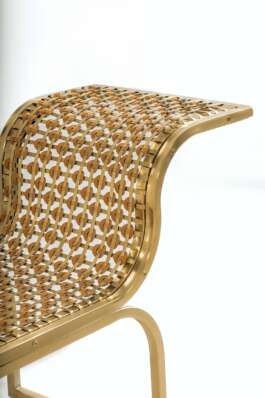
Artisanal Abode, Craft Nouveau Bench (detail). © Artisanal Abode
COLLECTIBLE: How did you get into contemporary collectible design? What drew you to this way of working?
Artisanal Abode: To be honest, the intent was never to create collectible design. Our primary pursuit has always been to experiment with craft-based techniques and materials in contemporary new ways. As we continued to push boundaries and go deeper into this exploration we arrived in a space that is more collectible in nature.
C: What makes a design collectible in your eyes?
AA: We believe collectibility is defined not simply by rarity, but by the strength of an idea and the distinctiveness of its execution. A collectible piece should speak to you personally and evoke a sense of curiosity, identity and timeless appeal. What interests us is the moment when an object begins to transcend its intended function and establishes a presence of its own. It may be through an unconventional use of material, an unexpected silhouette, or a construction technique that challenges established possibilities.
C: How has your practice evolved since you began working in the field?
AA: Our early explorations were largely concerned with understanding the behaviour of metal and how traditional weaving techniques could be adapted to a material that resists flexibility. As our understanding deepened, the technique began to inform the design itself. We moved from applying woven surfaces to furniture to allowing the weave to determine form, structure and movement.
Today, our practice is increasingly focused on creating objects where material and construction become inseparable from the artistic expression. We are interested in pushing the boundaries of what woven metal can become, moving towards more sculptural, experimental and architecturally expressive pieces.
C: What are the key questions you ask yourself before beginning a new piece?
AA: We often begin by asking what the material could do differently or how a craft technique can be applied beyond conventional norms. Can a rigid surface appear fluid? Can something inherently structural feel delicate? Can an object reveal its construction rather than conceal it?
We are equally interested in understanding whether a piece introduces a new perspective to our existing body of work. Experimentation for its own sake is rarely enough; there needs to be a compelling relationship between the concept, the material and the final form. Perhaps the most important question is whether the object expresses something that could not be communicated as effectively through another material or technique.
C: How do materials shape the direction of your work?
AA: Material is often the starting point rather than the final consideration in our practice. Working with stainless steel, brass and copper has allowed us to explore the contrasting qualities of rigidity and flexibility, precision and irregularity, weight and visual lightness. Metal weaving introduces an additional dimension, as each strip responds to the tension and movement of the strips surrounding it.
These characteristics frequently lead us towards forms we may not have initially imagined. Rather than forcing a predetermined design onto the material, we allow its behaviour, limitations and unexpected possibilities to shape the outcome.
C: How do you navigate the relationship between experimentation and functionality?
AA: We do not see experimentation and functionality as opposing forces. In fact, the constraints of function often create some of the most interesting design possibilities. Our approach is to allow the sculptural idea to develop freely before resolving the technical challenges of construction, stability and usability. The engineering is integral to this process, but we prefer it to remain visually understated.
There is something compelling about an object that appears effortless or even improbable, yet performs its function with precision. We are interested in achieving this balance without allowing technical necessity to dilute the original expression.
C: Can you talk about a new piece or collection you are presenting at COLLECTIBLE New York this year?
AA: For COLLECTIBLE New York, we have been exploring the idea of metal as a draped, almost textile-like surface, allowing woven structures to move beyond conventional geometric forms. One of the central explorations is a sculptural bar cabinet where a woven metal surface wraps around a monolithic volume, creating a dialogue between concealment and revelation, rigidity and movement.
The collection reflects our growing interest in treating woven metal not merely as a surface treatment, but as an expressive medium capable of defining the architecture of an object. We want the pieces to feel as much like sculptures as functional furniture.
C: What would you like visitors to understand after encountering your work at the fair?
AA: We would like visitors to reconsider their perception of metal, not simply as a rigid industrial material, but as something capable of softness, movement and an almost textile-like expression. Our work draws on the intelligence of traditional weaving, yet the intention is not to reproduce an existing craft aesthetic. It is to explore what happens when that knowledge is reinterpreted through an entirely different material and contemporary design sensibility.
If visitors leave with a sense of curiosity about how the objects were conceived and constructed, and a changed understanding of what metal can express, we would consider that meaningful.
About Artisanal Abode
Founded by Upasana Jain, a graduate of the National Institute of Design, Ahmedabad, and NYU Tisch School of the Arts, Artisanal Abode is a contemporary design studio based in Pune, India, exploring the intersection of craft, material research and collectible design.
Rooted in India’s diverse traditions of making, the studio approaches craftsmanship not as a heritage to be preserved unchanged, but as a source of knowledge capable of generating new design possibilities. Working closely with skilled artisans and fabricators, Artisanal Abode brings traditional techniques into dialogue with contemporary experimentation and engineering.
Central to its practice is Weaving in Metal, an ongoing material investigation that translates the principles of basketry into stainless steel, brass and copper. Through hand-weaving, manipulation and experimentation with structure, density and finish, inherently rigid materials acquire an unexpected sense of softness, movement and fluidity.
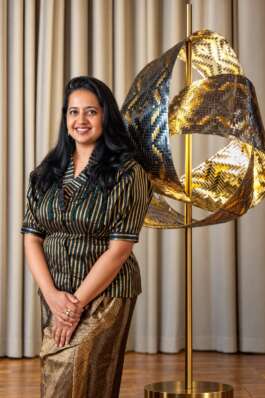
Upasana Jain, Artisanal Abode. © Edward Bishop
Upasana Jain, INTERLACE Sculptural Lighting, 2026. Stainless steel, cane and copper, 1200 × 800 mm. © Artisanal Abode
Artisanal Abode, Craft Nouveau Bench (detail). © Artisanal Abode
"There is something compelling about an object that appears effortless or even improbable, yet performs its function with precision."
Artisanal Abode, Craft Nouveau Bench (detail). © Artisanal Abode
Upasana Jain, Artisanal Abode. © Edward Bishop
