

Haoming Li. © Joey Wang
COLLECTIBLE In-Depth
hm-LI Studio
October 2026
COLLECTIBLE In-Depth goes behind the scenes of contemporary creation. From the private processes of individual designers to the place of collectible design in the global market, each conversation offers a different way into the field. Today we speak with Haoming Li of hm-LI Studio.
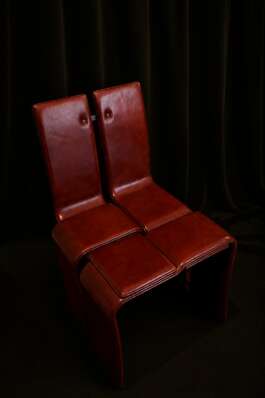
Haoming Li, Weaving Chair, 2025. Dashing Whiskey cowhide leather, W 48.6 × D 50.6 × H 84 cm. © hm-LI Studio
"What matters is that the narrative feels embedded in the object rather than applied to it afterward."
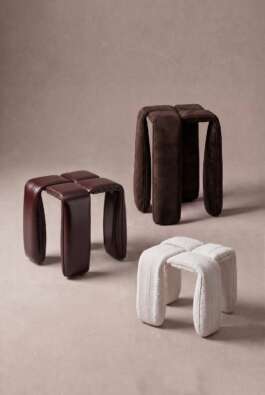
Haoming Li, Weaving Stool 03 Series, 2026. Leather and textured textile upholstery in multiple finishes. © hm-LI Studio
COLLECTIBLE: How did you get into contemporary collectible design? What drew you to this way of working?
Haoming Li: I trained in architecture, but gradually became more interested in the scale of furniture and the direct relationship between an idea, material, construction, and the body. Collectible design gave me the freedom to develop an object from a strong concept without separating form from how it is made. That became the foundation of hm-LI Studio. Today, my practice moves between independent collections and project-specific furniture, but in both I am interested in using furniture to translate a narrative into something physical, functional, and emotionally present.
C: What makes a design collectible in your eyes?
HL: For me, a collectible piece begins with a clear idea and develops its own identity through form, material, and construction. I am less interested in rarity for its own sake than in whether an object has a point of view that feels difficult to replace. It should reveal more the longer you live with it. Sometimes that identity comes from a material or structural idea; sometimes it carries the character of a particular culture or place. What matters is that the narrative feels embedded in the object rather than applied to it afterward.
C: What are the key questions you ask yourself before beginning a new piece?
HL: I usually start by asking what the central idea of the piece is and whether it is strong enough to guide everything that follows. What should determine the form? What role does the material play? How should the object feel when someone approaches, touches, or uses it? For project-specific work, another layer enters: what is the larger narrative of the space, and how can the furniture respond without illustrating it too literally? I try to find one clear idea and allow it to shape the object from concept through construction.
C: When designing an object, how much do you imagine the space or context in which it will eventually live?
HL: It depends on the project. Some of my independent work begins with an idea internal to the object itself, while project-specific work often begins with the larger narrative of a space. In hospitality projects, I look closely at the architecture, culture, materials, and atmosphere, then translate those qualities without relying on obvious motifs or literal references. I am interested in furniture that can belong deeply to a particular context while still feeling contemporary and complete as an object in its own right.
C: Can you talk about a new piece or collection you are presenting at COLLECTIBLE New York this year?
HL: The Weaving Collection has been part of my practice for several years, but I continue to develop it rather than treat it as a finished series. For COLLECTIBLE New York, I’m presenting new pieces within the collection, including different stool variations, new finishes, and shifts in scale and proportion. Some forms are fuller and more substantial, while others are thinner and more refined. I’m interested in seeing how the same idea of interlacing can keep evolving through material, proportion, and typology without losing the identity of the collection.
C: What would you like visitors to understand after encountering your work at the fair?
HL: I hope visitors first respond to the work intuitively, through its form, material, proportion, and presence. Behind each piece there is usually a clear narrative, but I do not think it needs to be immediately explained. I am interested in translating an idea into furniture in a way that feels natural rather than illustrative. Whether that idea begins with a gesture like weaving or grows from the architecture and culture of a particular project, I want the final object to have both a strong identity of its own and a deeper story behind it.
About hm-LI Studio
hm-LI Studio is a New York-based design practice working across collectible furniture, bespoke commissions and concept-driven spatial design. Founded by designer Haoming Li, the studio explores the relationship between objects, materials and architecture, approaching furniture as an extension of space rather than as an isolated object.
Rooted in architectural thinking, the studio’s work balances sculptural expression with everyday functionality through refined proportions, tactile materials and carefully considered construction. Across furniture collections, custom pieces and spatial concepts, hm-LI Studio develops a continuous design language shaped by materiality, atmosphere and human interaction.
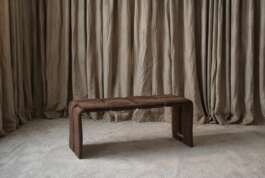
Haoming Li, Weaving Bench, 2026. Mocha velvet, L 111.6 × W 40.3 × H 45 cm. © hm-LI Studio
Haoming Li. © Joey Wang
Haoming Li, Weaving Chair, 2025. Dashing Whiskey cowhide leather, W 48.6 × D 50.6 × H 84 cm. © hm-LI Studio
"What matters is that the narrative feels embedded in the object rather than applied to it afterward."
Haoming Li, Weaving Stool 03 Series, 2026. Leather and textured textile upholstery in multiple finishes. © hm-LI Studio
Haoming Li, Weaving Bench, 2026. Mocha velvet, L 111.6 × W 40.3 × H 45 cm. © hm-LI Studio
