
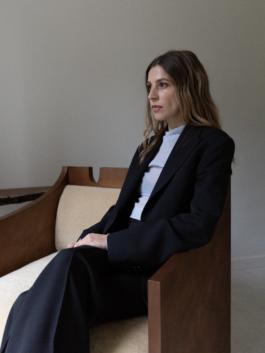

© Chloé Le Reste
COLLECTIBLE In-Depth
Katja Pargger
October 2026
COLLECTIBLE In-Depth goes behind the scenes of contemporary creation. From the private processes of individual designers to the place of collectible design in the global market, each conversation offers a different way into the field. Today we speak with Katja Pargger.
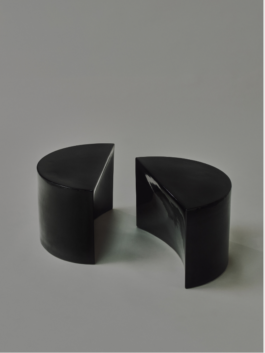
Katja Pargger, Half Moon tables, 2024. Hand-thrown black glazed ceramic. © Mathilde Hiley
COLLECTIBLE: How did you get into contemporary collectible design? What drew you to this way of working?
Katja Pargger: I came to furniture through architecture. I never wanted to stop at the shell of a building: the atmosphere of a place takes shape through its interiors, its materials, its light and its furniture. Over the years, approaching these elements as a whole, without fixed boundaries between disciplines, has become essential to my practice, and clients increasingly come to me for that complete vision. Furniture grew naturally out of this approach and gradually became a field of exploration in its own right, with a more immediate relationship to the body.
C: What are the key questions you ask yourself before beginning a new piece?
KP: I usually begin with a use, a gesture or a spatial situation. How will someone sit, lean, gather or move around the piece? What should its proportions be, and how much material does it really need? I look for a clear form, with details that feel necessary. Comfort is important, and so is the way an object occupies a room when nobody is using it. I want a piece to have presence while leaving space for the life around it.
C: How do materials shape the direction of your work?
KP: Once the use is clear, the material quickly takes over. Its weight, flexibility, surface and limitations shape both form and construction. I am drawn to the meeting of different qualities: the softness of leather against steel, the depth of a ceramic glaze, the way parchment filters light. These relationships guide the design as much as any drawing. I also look for materials that gain depth through use. The way leather softens, or a surface acquires a patina, is something I take into account as soon as the material is chosen.
"A piece needs to remain interesting long after the first encounter, through its comfort, an unexpected detail or the way its material changes with use."
C: When designing an object, how much do you imagine the space or context in which it will eventually live?
KP: I always imagine an object in relation to a space: the light, the distance from a wall, the circulation around it, how it sits alongside other pieces. My architectural practice makes these questions instinctive. Even when a piece is conceived for a specific interior, I want it to find its place elsewhere. What interests me are objects that bring structure to a room, through a curve, a low horizontal line or a shift in scale, while remaining open to the way each place is lived in.

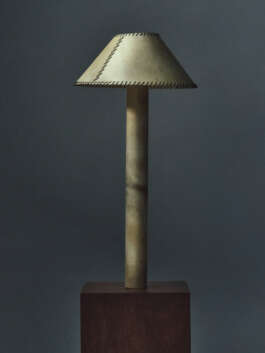
Katja Pargger, Skin Series / Lamp, 2024. Natural goatskin parchment, Ø 350 · H 600 mm. © Mathilde Hiley
C: Can you talk about a new piece or collection you are presenting at COLLECTIBLE New York this year?
KP: My presentation brings together seating, tables, lighting and a room divider, including pieces from the SKIN Series, which explores the relationship between leather, structure and the body. Leather is central to this work, alongside stainless steel, ceramic and parchment. I approach the presentation as a small interior, paying close attention to how the pieces relate to one another. It brings my architectural thinking into a concentrated setting, where visitors can experience the materials, the proportions and the relationships between objects at close range.
C: Beyond rarity or edition size, what gives a design object lasting value for a collector?
KP: Lasting value begins with the quality of the idea, the proportions and the making. But it grows through the bond someone develops with an object over time. A piece needs to remain interesting long after the first encounter, through its comfort, an unexpected detail or the way its material changes with use. What I like most is the thought of an object becoming part of someone’s daily life, gathering memories, and eventually being passed on.
About Katja Pargger
Katja Pargger is an Austrian architect based in Paris. Born in Tyrol, she studied architecture in Innsbruck before moving to Paris, where she founded her architectural practice in 2013.
Her work is rooted in architecture and extends from the restoration and transformation of historic buildings to private residences, hospitality and workspaces. Each project is approached as a whole, from the architecture and its relationship to the existing structure through to interiors, furniture and objects. Material, proportion and use form a continuous part of this process. Furniture has developed naturally from this architectural practice. Pieces are often drawn alongside the spaces they inhabit rather than introduced afterwards, emerging from a particular proportion, material or need. This same attention to construction, craft and the way materials age runs throughout Pargger’s work.
Since 2024, her furniture, lighting, textiles and objects have been brought together under ITEMS. Produced in limited editions with specialized workshops, these pieces can exist independently while retaining their architectural origins. Pargger’s work has been published internationally in T: The New York Times Style Magazine, M Le Magazine du Monde, Wallpaper* and the Financial Times.
She was named an AD100 International Newcomer by AD Germany in 2025 and selected for the AD100 France and AD100 Germany lists in 2026.

© Chloé Le Reste

© Chloé Le Reste
COLLECTIBLE In-Depth
Katja Pargger
October 2026
COLLECTIBLE In-Depth goes behind the scenes of contemporary creation. From the private processes of individual designers to the place of collectible design in the global market, each conversation offers a different way into the field. Today we speak with Katja Pargger.

Katja Pargger, Half Moon tables, 2024. Hand-thrown black glazed ceramic. © Mathilde Hiley
COLLECTIBLE: How did you get into contemporary collectible design? What drew you to this way of working?
Katja Pargger: I came to furniture through architecture. I never wanted to stop at the shell of a building: the atmosphere of a place takes shape through its interiors, its materials, its light and its furniture. Over the years, approaching these elements as a whole, without fixed boundaries between disciplines, has become essential to my practice, and clients increasingly come to me for that complete vision. Furniture grew naturally out of this approach and gradually became a field of exploration in its own right, with a more immediate relationship to the body.
C: What are the key questions you ask yourself before beginning a new piece?
KP: I usually begin with a use, a gesture or a spatial situation. How will someone sit, lean, gather or move around the piece? What should its proportions be, and how much material does it really need? I look for a clear form, with details that feel necessary. Comfort is important, and so is the way an object occupies a room when nobody is using it. I want a piece to have presence while leaving space for the life around it.
C: How do materials shape the direction of your work?
KP: Once the use is clear, the material quickly takes over. Its weight, flexibility, surface and limitations shape both form and construction. I am drawn to the meeting of different qualities: the softness of leather against steel, the depth of a ceramic glaze, the way parchment filters light. These relationships guide the design as much as any drawing. I also look for materials that gain depth through use. The way leather softens, or a surface acquires a patina, is something I take into account as soon as the material is chosen.
"A piece needs to remain interesting long after the first encounter, through its comfort, an unexpected detail or the way its material changes with use."
C: When designing an object, how much do you imagine the space or context in which it will eventually live?
KP: I always imagine an object in relation to a space: the light, the distance from a wall, the circulation around it, how it sits alongside other pieces. My architectural practice makes these questions instinctive. Even when a piece is conceived for a specific interior, I want it to find its place elsewhere. What interests me are objects that bring structure to a room, through a curve, a low horizontal line or a shift in scale, while remaining open to the way each place is lived in.

Katja Pargger, Skin Series / Lamp, 2024. Natural goatskin parchment, Ø 350 · H 600 mm. © Mathilde Hiley
C: Can you talk about a new piece or collection you are presenting at COLLECTIBLE New York this year?
KP: My presentation brings together seating, tables, lighting and a room divider, including pieces from the SKIN Series, which explores the relationship between leather, structure and the body. Leather is central to this work, alongside stainless steel, ceramic and parchment. I approach the presentation as a small interior, paying close attention to how the pieces relate to one another. It brings my architectural thinking into a concentrated setting, where visitors can experience the materials, the proportions and the relationships between objects at close range.
C: Beyond rarity or edition size, what gives a design object lasting value for a collector?
KP: Lasting value begins with the quality of the idea, the proportions and the making. But it grows through the bond someone develops with an object over time. A piece needs to remain interesting long after the first encounter, through its comfort, an unexpected detail or the way its material changes with use. What I like most is the thought of an object becoming part of someone’s daily life, gathering memories, and eventually being passed on.
About Katja Pargger
Katja Pargger is an Austrian architect based in Paris. Born in Tyrol, she studied architecture in Innsbruck before moving to Paris, where she founded her architectural practice in 2013.
Her work is rooted in architecture and extends from the restoration and transformation of historic buildings to private residences, hospitality and workspaces. Each project is approached as a whole, from the architecture and its relationship to the existing structure through to interiors, furniture and objects. Material, proportion and use form a continuous part of this process. Furniture has developed naturally from this architectural practice. Pieces are often drawn alongside the spaces they inhabit rather than introduced afterwards, emerging from a particular proportion, material or need. This same attention to construction, craft and the way materials age runs throughout Pargger’s work.
Since 2024, her furniture, lighting, textiles and objects have been brought together under ITEMS. Produced in limited editions with specialized workshops, these pieces can exist independently while retaining their architectural origins. Pargger’s work has been published internationally in T: The New York Times Style Magazine, M Le Magazine du Monde, Wallpaper* and the Financial Times.
She was named an AD100 International Newcomer by AD Germany in 2025 and selected for the AD100 France and AD100 Germany lists in 2026.

© Chloé Le Reste