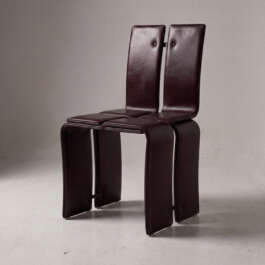
© hm-LI Studio
COLLECTIBLE In-Depth
hm-LI Studio
March 2026
This series, COLLECTIBLE In-Depth, unveils the backstage of contemporary creation. Tackling various topics from personal designer processes to the position of collectible design on the global design market, COLLECTIBLE In-Depth offers different views to suit all tastes. Today we speak with hm-LI Studio.
COLLECTIBLE: Why do you focus on contemporary collectible design? What does it mean to you?
hm-LI Studio: Collectible design gives me the right pace to make meaning visible. Working in small series, I can refine proportion, material, and construction until the object holds a clear presence - useful, yet sculptural. I’m drawn to emotional minimalism: forms that speak quietly but stay with you. Rather than optimizing for quantity, I focus on how an object lives in time - how it gathers touch, patina, and memory. In that sense, concept, making, and meaning are inseparable.
C: What makes a design collectible in your eyes?
hS: A special item is more than just something you use - it's a way of thinking. It has a unique style, is made with good materials, and has a story that you can sense without needing to be told. I often think that the idea behind something is more important than what it's used for, not because I don't care about using it, but because I want to make it more meaningful. For example, a watch can be more than just a way to tell time - it can be a part of who you are. When something is designed in a way that you can use it every day and it still feels special or emotional - showing something about the person who made it and its own history - that's when it becomes really valuable.
C: What are the key questions you ask yourself before starting to conceptualise a new piece?
hS: You know how sometimes you get a feeling that sparks an idea - it might be a place that inspires you, a sound that moves you, or a moment in time that stays with you, like sitting in a beautiful garden and listening to the rain hit the stones. Then, you start to think more critically about how to bring that feeling to life. I start by asking myself some questions: what kind of shape would best capture this feeling - should it be a circle, an ellipse, or something more organic? What size would create the right balance between the person experiencing it and the object itself? What material would hold onto the mood and feeling over time, not just when it's new, but as it ages and wears? And what can I take away, or simplify, so that the emotion and feeling stay clear and strong? By asking these questions, I can take a vague memory or feeling and turn it into something real and tangible, with a clear form and shape.
C: How do you question or challenge functionality in your design process?
hS: I respect use, because intimacy is how objects gain meaning. But I resist treating function as the sole measure of value. I’m interested in structures where a single gesture can carry multiple roles, including support, comfort, and expression, without adding unnecessary complexity. At times spirituality and practicality conflict; at other times they reinforce one another. A strong piece does not simply compromise between the two, but holds them in tension. Different works may serve different audiences, yet I am always working toward designs where function deepens the concept and the concept elevates the experience of use.
C: How does the digital sphere influence your work? What is your relationship to 3D, AI, or other digital tools?
hS: Digital tools help me test proportion, light, and surface early, and quickly explore variations. AI can widen context and mood, but only when the designer knows what to ask. Random generation leads to generic output; precise questions sharpen intention. Ultimately, decisions are grounded in hand studies and full-scale mockups - the body is the final judge. Digital accelerates iteration; craft and lived experience set the truth.
C: What advice would you give to someone starting a collection of contemporary design?
hS: Collect slowly. Live with materials and notice what you reach for - warmth, weight, softness, silence. Look for clarity of intent, strong proportions, and honest construction (visible or elegantly concealed). Ask about edition size, repairability, and whether the piece can be refinished over time. Meet the maker if possible; the story should be something you can carry in your own words. The best pieces don’t shout - they become more inevitable the longer they’re with you.

© hm-LI Studio, photo by Joey Wang

© hm-LI Studio
COLLECTIBLE In-Depth
hm-LI Studio
March 2026
This series, COLLECTIBLE In-Depth, unveils the backstage of contemporary creation. Tackling various topics from personal designer processes to the position of collectible design on the global design market, COLLECTIBLE In-Depth offers different views to suit all tastes. Today we speak with hm-LI Studio.
COLLECTIBLE: Why do you focus on contemporary collectible design? What does it mean to you?
hm-LI Studio: Collectible design gives me the right pace to make meaning visible. Working in small series, I can refine proportion, material, and construction until the object holds a clear presence - useful, yet sculptural. I’m drawn to emotional minimalism: forms that speak quietly but stay with you. Rather than optimizing for quantity, I focus on how an object lives in time - how it gathers touch, patina, and memory. In that sense, concept, making, and meaning are inseparable.
C: What makes a design collectible in your eyes?
hS: A special item is more than just something you use - it's a way of thinking. It has a unique style, is made with good materials, and has a story that you can sense without needing to be told. I often think that the idea behind something is more important than what it's used for, not because I don't care about using it, but because I want to make it more meaningful. For example, a watch can be more than just a way to tell time - it can be a part of who you are. When something is designed in a way that you can use it every day and it still feels special or emotional - showing something about the person who made it and its own history - that's when it becomes really valuable.
C: What are the key questions you ask yourself before starting to conceptualise a new piece?
hS: You know how sometimes you get a feeling that sparks an idea - it might be a place that inspires you, a sound that moves you, or a moment in time that stays with you, like sitting in a beautiful garden and listening to the rain hit the stones. Then, you start to think more critically about how to bring that feeling to life. I start by asking myself some questions: what kind of shape would best capture this feeling - should it be a circle, an ellipse, or something more organic? What size would create the right balance between the person experiencing it and the object itself? What material would hold onto the mood and feeling over time, not just when it's new, but as it ages and wears? And what can I take away, or simplify, so that the emotion and feeling stay clear and strong? By asking these questions, I can take a vague memory or feeling and turn it into something real and tangible, with a clear form and shape.
C: How do you question or challenge functionality in your design process?
hS: I respect use, because intimacy is how objects gain meaning. But I resist treating function as the sole measure of value. I’m interested in structures where a single gesture can carry multiple roles, including support, comfort, and expression, without adding unnecessary complexity. At times spirituality and practicality conflict; at other times they reinforce one another. A strong piece does not simply compromise between the two, but holds them in tension. Different works may serve different audiences, yet I am always working toward designs where function deepens the concept and the concept elevates the experience of use.
C: How does the digital sphere influence your work? What is your relationship to 3D, AI, or other digital tools?
hS: Digital tools help me test proportion, light, and surface early, and quickly explore variations. AI can widen context and mood, but only when the designer knows what to ask. Random generation leads to generic output; precise questions sharpen intention. Ultimately, decisions are grounded in hand studies and full-scale mockups - the body is the final judge. Digital accelerates iteration; craft and lived experience set the truth.
C: What advice would you give to someone starting a collection of contemporary design?
hS: Collect slowly. Live with materials and notice what you reach for - warmth, weight, softness, silence. Look for clarity of intent, strong proportions, and honest construction (visible or elegantly concealed). Ask about edition size, repairability, and whether the piece can be refinished over time. Meet the maker if possible; the story should be something you can carry in your own words. The best pieces don’t shout - they become more inevitable the longer they’re with you.

© hm-LI Studio, photo by Joey Wang