© Jeroen Vranken
COLLECTIBLE In-Depth
Janne Claes
March 2026
This series, COLLECTIBLE In-Depth, unveils the backstage of contemporary creation. Tackling various topics from personal designer processes to the position of collectible design on the global design market, COLLECTIBLE In-Depth offers different views to suit all tastes. Today we speak with Janne Claes.
COLLECTIBLE: Can you talk about a new piece or collection you are presenting at COLLECTIBLE this year?
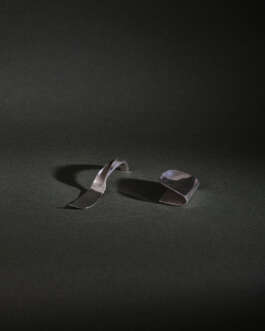
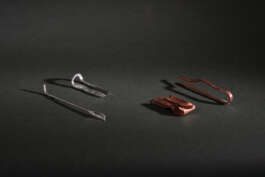
Janne Claes: The work shown at Collectible was first presented as part of a performative installation titled ‘Come for Dessert’, where participants were invited to consume edible versions of objects I created, further questioning the value of form and materiality.
I'm fascinated by the idea of cutlery, as it embodies a duality of values between object, materiality, and function. A set of utensils whose “value” and role in daily life shifts depending on the material from which it is made. By extending this idea not only to materiality but also to form, I aim to create a tension between the utility and the intended form of use. This places the user or viewer in a scenario where they are prompted to choose between different “design objects” and engage with them in everyday practice. This interaction triggers a shift in value, where the designed object initially becomes mundane, only to reclaim the significance attributed by the user afterward.
C: What have you been up to recently? What are the next projects or exhibitions you wish to highlight?
JC: My practice and objects come to life through audience interactions, therefore a new dinner format will be developed next months, continuing the concept I presented last year, “Come for Dessert.” These interactions with my objects give space to research on behavior and a social confrontation: how interpretations of certain settings and objects make people behave. Further, I continue developing unique objects within my object language under the research title "De (On)eindigheid van het (On)gecontroleerde", or in English, the (In)finity of the (Un)controlled. There is still much to develop in moving from abstracting ideas of function to re-giving function to objects.
C: How did you get into collectible design? Why did you focus your practice on this type of design rather than industrial design?
JC: I never saw myself as being in the practice of collectible design. Over the years, I developed a research that touched both art and design. For me, the symbiosis and the term that collectible design now provides is an ideal way of presenting my work in a more concrete format, where both aspects of art and design can be present.
C: If you were to collaborate with someone outside of the design scene, from another industry, who would you pick?
JC: I have always believed in cross-pollination and would love to see how certain types, or contrasting yet complementary pieces, could work with my objects. Normally, I design my own presentation and furniture that function for the objects. But I also see it as a value to step away and collaborate with somebody who can provide new input on presenting my works. For me both the presentation design is as important as the objects (Utensils) that are presented. Besides that, at the moment I am in constant search of chefs who can collaborate with me through my utensils to create new dinner moments.
C: Who has mentored or influenced your practice?
JC: The creation process of textile design has greatly influenced the process of creating my objects. In textile design, you create a surface, but this surface needs to find its place in a context: is it for clothing, is it for interior, is it a unique piece? Translated into other materials, this methodology is a framework for me.
C: Where do you take your inspiration from?
JC: The ideology of the Bauhaus has always inspired me and influenced me in thinking about the relationship between art, design, and functionality. It is not in style that they influenced me the most, but in their way of thinking. The integration of craft, material, function, and the idea that form and function are connected, stayed with me. At the same time, I am interested in looking at these boundaries, whether form follows function, or whether function can also follow form. This duality between the two continues to be present in my work.
C: Are you more result- or process-oriented?
JC: I see my work as a continuous process, and that is also the meaning of my research. All pieces somehow create a further story, and you cannot really see my work separately from the original forms. But participating in this collectible design fair gives me the opportunity to see if the objects can stand on their own and create meaning independently.
C: What is your favourite material?
JC: The affinity with each individual material and the way materials behave is for me an inspiration. I feel and listen to materials and look at how they can be manipulated and transformed. I work with materials that can be built up, that allow a certain reversibility in the process. Materials that can return to their raw state and be formed again such as ceramics that can be granulated and rehydrated into clay, or silver/metals that can be melted and cast again. I am less drawn to materials that require a subtractive approach, where form is carved out of a fixed raw mass, such as stone or wood. The possibility of rebuilding, re-melting, or re-forming is something that feels more aligned with my way of working.
© Jeroen Vranken
© Janne Claes, photo by Jeroen Vranken
© Jeroen Vranken
COLLECTIBLE In-Depth
Janne Claes
March 2026
This series, COLLECTIBLE In-Depth, unveils the backstage of contemporary creation. Tackling various topics from personal designer processes to the position of collectible design on the global design market, COLLECTIBLE In-Depth offers different views to suit all tastes. Today we speak with Janne Claes.
COLLECTIBLE: Can you talk about a new piece or collection you are presenting at COLLECTIBLE this year?
Janne Claes: The work shown at Collectible was first presented as part of a performative installation titled ‘Come for Dessert’, where participants were invited to consume edible versions of objects I created, further questioning the value of form and materiality.
I'm fascinated by the idea of cutlery, as it embodies a duality of values between object, materiality, and function. A set of utensils whose “value” and role in daily life shifts depending on the material from which it is made. By extending this idea not only to materiality but also to form, I aim to create a tension between the utility and the intended form of use. This places the user or viewer in a scenario where they are prompted to choose between different “design objects” and engage with them in everyday practice. This interaction triggers a shift in value, where the designed object initially becomes mundane, only to reclaim the significance attributed by the user afterward.
C: What have you been up to recently? What are the next projects or exhibitions you wish to highlight?
JC: My practice and objects come to life through audience interactions, therefore a new dinner format will be developed next months, continuing the concept I presented last year, “Come for Dessert.” These interactions with my objects give space to research on behavior and a social confrontation: how interpretations of certain settings and objects make people behave. Further, I continue developing unique objects within my object language under the research title "De (On)eindigheid van het (On)gecontroleerde", or in English, the (In)finity of the (Un)controlled. There is still much to develop in moving from abstracting ideas of function to re-giving function to objects.
C: How did you get into collectible design? Why did you focus your practice on this type of design rather than industrial design?
JC: I never saw myself as being in the practice of collectible design. Over the years, I developed a research that touched both art and design. For me, the symbiosis and the term that collectible design now provides is an ideal way of presenting my work in a more concrete format, where both aspects of art and design can be present.
C: If you were to collaborate with someone outside of the design scene, from another industry, who would you pick?
JC: I have always believed in cross-pollination and would love to see how certain types, or contrasting yet complementary pieces, could work with my objects. Normally, I design my own presentation and furniture that function for the objects. But I also see it as a value to step away and collaborate with somebody who can provide new input on presenting my works. For me both the presentation design is as important as the objects (Utensils) that are presented. Besides that, at the moment I am in constant search of chefs who can collaborate with me through my utensils to create new dinner moments.
C: Who has mentored or influenced your practice?
JC: The creation process of textile design has greatly influenced the process of creating my objects. In textile design, you create a surface, but this surface needs to find its place in a context: is it for clothing, is it for interior, is it a unique piece? Translated into other materials, this methodology is a framework for me.
C: Where do you take your inspiration from?
JC: The ideology of the Bauhaus has always inspired me and influenced me in thinking about the relationship between art, design, and functionality. It is not in style that they influenced me the most, but in their way of thinking. The integration of craft, material, function, and the idea that form and function are connected, stayed with me. At the same time, I am interested in looking at these boundaries, whether form follows function, or whether function can also follow form. This duality between the two continues to be present in my work.
C: Are you more result- or process-oriented?
JC: I see my work as a continuous process, and that is also the meaning of my research. All pieces somehow create a further story, and you cannot really see my work separately from the original forms. But participating in this collectible design fair gives me the opportunity to see if the objects can stand on their own and create meaning independently.
C: What is your favourite material?
JC: The affinity with each individual material and the way materials behave is for me an inspiration. I feel and listen to materials and look at how they can be manipulated and transformed. I work with materials that can be built up, that allow a certain reversibility in the process. Materials that can return to their raw state and be formed again such as ceramics that can be granulated and rehydrated into clay, or silver/metals that can be melted and cast again. I am less drawn to materials that require a subtractive approach, where form is carved out of a fixed raw mass, such as stone or wood. The possibility of rebuilding, re-melting, or re-forming is something that feels more aligned with my way of working.
© Janne Claes, photo by Jeroen Vranken
