
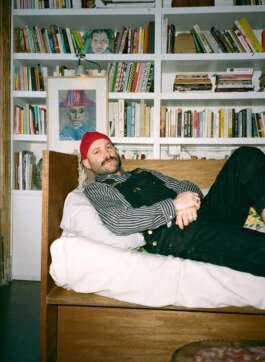
© Alex Tieghi-Walker by Rafael Martinez
COLLECTIBLE Three questions to
Alex Tieghi-Walker
July 2026
Today, we have the pleasure of speaking with Alex Tieghi-Walker, a British-Italian curator, writer, and gallerist, who is curating the CURATED section of COLLECTIBLE New York 2026. As the founder of TIWA Select and TIWA Gallery in New York, he has built a distinctive platform dedicated to contemporary craft, collectible design, and material-led practices. For this edition’s theme, Human Resources, Alex Tieghi-Walker explores ambition, labor, and systems of value through the lens of the corporate environment, reimagining the office as a space for reflection and reinvention. In our conversation, he shares the ideas behind the project, his approach to transforming everyday environments through design, and his vision for more creative and humane spaces.
COLLECTIBLE: You’re building Human Resources from a concept rather than a space. What was the moment or image that made you want to look at the office through collectible design in the first place?
Alex Tieghi-Walker: Last March, I curated a show at the Shop at Sadie Coles HQ called Office Hours. It was essentially a reconstruction of what my own studio or office might look like within a London gallery context. Plot spoiler: it was messy.
That project got me thinking about workspaces more generally and what they should actually mean. We spend arguably more of our lives in work environments than anywhere else, so I wanted to create an exhibition that took that premise and pushed it further. What do other people think a workplace could look like? How should we design for the way we work today?
The workplace has undergone huge change over the past decade. The pandemic emptied offices, while artists and makers increasingly sought live-work spaces that blur the line between public and private life, between work and leisure. Office buildings themselves have become strangely fluid: they sit empty, they’re converted into homes, or, in this case, they’re transformed into a design fair.
I’m interested in how we take somewhere traditionally designed around efficiency and productivity and instead shape it around values that feel more relevant in 2026: individuality, rest, creativity, generosity, and moments of reset. Human Resources is really an invitation to rethink what the office means today and to imagine how it could be better.
C: The exhibition treats the office less as a backdrop and more as a kind of system that shapes behaviour and desire. How do you begin to work with something like that without turning it into a straightforward aesthetic reference?
ATW: I think we all have a very fixed image of what an office is. Popular culture has reinforced it for decades: The Office, Severance, Mad Men, The Matrix, American Psycho, American Beauty. The office becomes a kind of shorthand for hierarchy, routine, and relentless productivity. And boredom.
I'm less interested in recreating that visual language than I am in examining the philosophy behind it. Offices aren't neutral spaces; they're designed to optimise behaviour and maximise productivity. Every decision, from lighting to furniture to circulation, exists to make people work more efficiently.
The exhibition asks how we arrived at that model, whether it still serves us, and what might come next. Rather than presenting the office as an aesthetic, I'm interested in it as a design system that can be questioned, reconfigured, and perhaps made more humane.
C: Your curatorial practice has developed across different contexts and formats. What aspects of your background or earlier experiences have most shaped the way you approach a project like Human Resources today?
ATW: I'm naturally curious. Before becoming a curator, I was a journalist, and I think I was drawn to journalism because I love discovering stories and sharing them with other people.
That instinct has never really changed. I'm fascinated by makers—their processes, their obsessions, their materials—and my role is often to understand those stories and create a framework through which other people can experience them.
Interestingly, I don't come from a traditional exhibition-making background, and I still have relatively limited experience with large group shows. Rather than organising exhibitions around a medium or movement, I've found myself creating environments that feel familiar—like a dining table, an office, or a domestic interior—and then inviting designers and artists to respond to those spaces.
Those everyday settings become vehicles for conversation. They're recognisable enough for people to enter intuitively, but they're also open enough to be reimagined through the work of the artists. That's become a recurring thread in my practice: using the ordinary as a way into something more speculative.
© Alex Tieghi-Walker by Rafael Martinez
COLLECTIBLE Three questions to
Alex Tieghi-Walker
July 2026
Today, we have the pleasure of speaking with Alex Tieghi-Walker, a British-Italian curator, writer, and gallerist, who is curating the CURATED section of COLLECTIBLE New York 2026. As the founder of TIWA Select and TIWA Gallery in New York, he has built a distinctive platform dedicated to contemporary craft, collectible design, and material-led practices. For this edition’s theme, Human Resources, Alex Tieghi-Walker explores ambition, labor, and systems of value through the lens of the corporate environment, reimagining the office as a space for reflection and reinvention. In our conversation, he shares the ideas behind the project, his approach to transforming everyday environments through design, and his vision for more creative and humane spaces.
COLLECTIBLE: You’re building Human Resources from a concept rather than a space. What was the moment or image that made you want to look at the office through collectible design in the first place?
Alex Tieghi-Walker: Last March, I curated a show at the Shop at Sadie Coles HQ called Office Hours. It was essentially a reconstruction of what my own studio or office might look like within a London gallery context. Plot spoiler: it was messy.
That project got me thinking about workspaces more generally and what they should actually mean. We spend arguably more of our lives in work environments than anywhere else, so I wanted to create an exhibition that took that premise and pushed it further. What do other people think a workplace could look like? How should we design for the way we work today?
The workplace has undergone huge change over the past decade. The pandemic emptied offices, while artists and makers increasingly sought live-work spaces that blur the line between public and private life, between work and leisure. Office buildings themselves have become strangely fluid: they sit empty, they’re converted into homes, or, in this case, they’re transformed into a design fair.
I’m interested in how we take somewhere traditionally designed around efficiency and productivity and instead shape it around values that feel more relevant in 2026: individuality, rest, creativity, generosity, and moments of reset. Human Resources is really an invitation to rethink what the office means today and to imagine how it could be better.
C: The exhibition treats the office less as a backdrop and more as a kind of system that shapes behaviour and desire. How do you begin to work with something like that without turning it into a straightforward aesthetic reference?
ATW: I think we all have a very fixed image of what an office is. Popular culture has reinforced it for decades: The Office, Severance, Mad Men, The Matrix, American Psycho, American Beauty. The office becomes a kind of shorthand for hierarchy, routine, and relentless productivity. And boredom.
I'm less interested in recreating that visual language than I am in examining the philosophy behind it. Offices aren't neutral spaces; they're designed to optimise behaviour and maximise productivity. Every decision, from lighting to furniture to circulation, exists to make people work more efficiently.
The exhibition asks how we arrived at that model, whether it still serves us, and what might come next. Rather than presenting the office as an aesthetic, I'm interested in it as a design system that can be questioned, reconfigured, and perhaps made more humane.
C: Your curatorial practice has developed across different contexts and formats. What aspects of your background or earlier experiences have most shaped the way you approach a project like Human Resources today?
ATW: I'm naturally curious. Before becoming a curator, I was a journalist, and I think I was drawn to journalism because I love discovering stories and sharing them with other people.
That instinct has never really changed. I'm fascinated by makers—their processes, their obsessions, their materials—and my role is often to understand those stories and create a framework through which other people can experience them.
Interestingly, I don't come from a traditional exhibition-making background, and I still have relatively limited experience with large group shows. Rather than organising exhibitions around a medium or movement, I've found myself creating environments that feel familiar—like a dining table, an office, or a domestic interior—and then inviting designers and artists to respond to those spaces.
Those everyday settings become vehicles for conversation. They're recognisable enough for people to enter intuitively, but they're also open enough to be reimagined through the work of the artists. That's become a recurring thread in my practice: using the ordinary as a way into something more speculative.
