
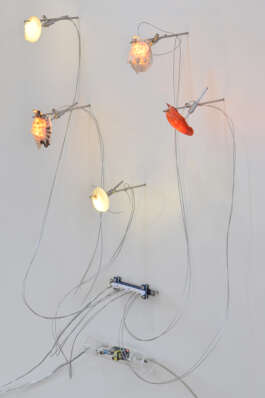
© Ludovico Grantaliano
COLLECTIBLE In-Depth
OXILIA GALLERY
March 2026
This series, COLLECTIBLE In-Depth, unveils the backstage of contemporary creation. Tackling various topics from personal designer processes to the position of collectible design on the global design market, COLLECTIBLE In-Depth offers different views to suit all tastes. Today we speak with OXILIA GALLERY.
COLLECTIBLE: How did you get into collectible design? Why did you start your gallery?
OXILIA GALLERY: Our backgrounds are in set design and interior architecture, so we’ve always been interested in objects not just as functional items but as carriers of narrative and atmosphere. Over time we became increasingly drawn to collectible design because it sits at the intersection of art, craft, and architecture. Starting the gallery came from a desire to create a space where these objects could be presented with the same level of attention and storytelling usually reserved for art. Rather than treating design as purely functional, we are interested in showing pieces that have a strong conceptual identity and that explore material, form, and symbolism in unexpected ways.
C: What have you been up to recently? What are the next projects or exhibitions you wish to highlight?
OG: Recently we have been focusing on developing a series of exhibitions that explore the relationship between material experimentation and narrative. At Collectible Brussels we are presenting MADRE, a new body of work by Ludovico Grantaliano that combines precise technical processes with irreducible natural elements, resulting in sculptural furniture pieces. The current exhibition in Milan is Clay Ink Paper by Arianna Lelli Mami, featuring a series of intimate sculptural environments—miniature architectures, cabinets and constructed stages—combining natural fragments, hybrid creatures, found objects and ceramic elements. Removed from their original function, these components are recomposed into new symbolic constellations. For the upcoming Milan Design Week in April we are working on Room Studies #1, a group show featuring some of our favourite European designers. These projects continue our interest in showing design that sits between disciplines and expands the language of collectible objects.
C: What are the key questions you ask yourself before starting to conceptualise an exhibition?
OG: Before developing an exhibition we usually ask ourselves a few fundamental questions: what conversation the work is entering, how the pieces relate to one another, and what kind of spatial or emotional experience the exhibition should create. We are interested in exhibitions that feel coherent but not overly didactic, where the objects can be read individually while still contributing to a broader narrative. Material presence, scale, and the atmosphere of the space are all part of that process.
C: Can you talk about a new piece or collection you are presenting at COLLECTIBLE this year?
Ludovico Grantaliano: For this edition of Collectible, I will present a selection of works produced over the past two years alongside several new pieces conceived specifically for the fair. My research explores the relationship between design and what I call the undesignable: elements that escape the author’s control and are incorporated into the project to produce unique, unrepeatable outcomes that cannot be fully determined during the design phase. All the pieces on display share this common language, seeking a form of symbiosis, both formal and functional, between rigorously designed artificial structures and natural elements whose behavior cannot be entirely predicted or controlled. The central works in the presentation are a series of luminous pieces: different iterations of MADRE, lamps generated from the form of a shell, a project I have been developing since 2024. This will be the first time the series is presented in a suspended configuration, installed between ceiling and floor.
C: `Where do you take your inspiration from?
LG: For me, inspiration emerges from everyday life and, more specifically, from the rhythm of daily practice. Working means constantly thinking through work; even things that may appear trivial or distant from artistic production often become the starting point for new ideas. Creation, for me, is a continuous flow rather than a sequence of isolated moments. At times, however, brief flashes of clarity appear, illuminating an idea that suddenly reveals its potential.
C: Are you more result- or process-oriented?
LG: What interests me most is the conceptual framework and the process through which each piece takes shape. My interest in natural or undesignable elements is also a way of deliberately relinquishing total control over the project.At the same time, I believe the final image remains crucial. It is the sensitive and empathetic form through which the work communicates with the public. It is the first encounter through which viewers perceive the practice and perhaps become curious to explore it further. In this sense, the visual result conveys the more physical and intuitive dimension of the work, the emotions that precede rational explanation.
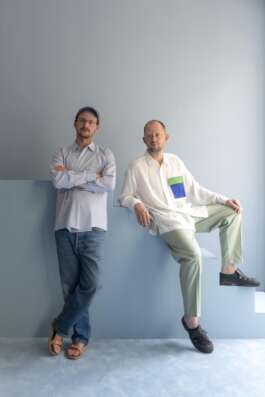
© Alessandro Mensi and Frederik de Wachter, photo by Michele Foti
© Ludovico Grantaliano
COLLECTIBLE In-Depth
OXILIA GALLERY
March 2026
This series, COLLECTIBLE In-Depth, unveils the backstage of contemporary creation. Tackling various topics from personal designer processes to the position of collectible design on the global design market, COLLECTIBLE In-Depth offers different views to suit all tastes. Today we speak with OXILIA GALLERY.
COLLECTIBLE: How did you get into collectible design? Why did you start your gallery?
OXILIA GALLERY: Our backgrounds are in set design and interior architecture, so we’ve always been interested in objects not just as functional items but as carriers of narrative and atmosphere. Over time we became increasingly drawn to collectible design because it sits at the intersection of art, craft, and architecture. Starting the gallery came from a desire to create a space where these objects could be presented with the same level of attention and storytelling usually reserved for art. Rather than treating design as purely functional, we are interested in showing pieces that have a strong conceptual identity and that explore material, form, and symbolism in unexpected ways.
C: What have you been up to recently? What are the next projects or exhibitions you wish to highlight?
OG: Recently we have been focusing on developing a series of exhibitions that explore the relationship between material experimentation and narrative. At Collectible Brussels we are presenting MADRE, a new body of work by Ludovico Grantaliano that combines precise technical processes with irreducible natural elements, resulting in sculptural furniture pieces. The current exhibition in Milan is Clay Ink Paper by Arianna Lelli Mami, featuring a series of intimate sculptural environments—miniature architectures, cabinets and constructed stages—combining natural fragments, hybrid creatures, found objects and ceramic elements. Removed from their original function, these components are recomposed into new symbolic constellations. For the upcoming Milan Design Week in April we are working on Room Studies #1, a group show featuring some of our favourite European designers. These projects continue our interest in showing design that sits between disciplines and expands the language of collectible objects.
C: What are the key questions you ask yourself before starting to conceptualise an exhibition?
OG: Before developing an exhibition we usually ask ourselves a few fundamental questions: what conversation the work is entering, how the pieces relate to one another, and what kind of spatial or emotional experience the exhibition should create. We are interested in exhibitions that feel coherent but not overly didactic, where the objects can be read individually while still contributing to a broader narrative. Material presence, scale, and the atmosphere of the space are all part of that process.
C: Can you talk about a new piece or collection you are presenting at COLLECTIBLE this year?
Ludovico Grantaliano: For this edition of Collectible, I will present a selection of works produced over the past two years alongside several new pieces conceived specifically for the fair. My research explores the relationship between design and what I call the undesignable: elements that escape the author’s control and are incorporated into the project to produce unique, unrepeatable outcomes that cannot be fully determined during the design phase. All the pieces on display share this common language, seeking a form of symbiosis, both formal and functional, between rigorously designed artificial structures and natural elements whose behavior cannot be entirely predicted or controlled. The central works in the presentation are a series of luminous pieces: different iterations of MADRE, lamps generated from the form of a shell, a project I have been developing since 2024. This will be the first time the series is presented in a suspended configuration, installed between ceiling and floor.
C: `Where do you take your inspiration from?
LG: For me, inspiration emerges from everyday life and, more specifically, from the rhythm of daily practice. Working means constantly thinking through work; even things that may appear trivial or distant from artistic production often become the starting point for new ideas. Creation, for me, is a continuous flow rather than a sequence of isolated moments. At times, however, brief flashes of clarity appear, illuminating an idea that suddenly reveals its potential.
C: Are you more result- or process-oriented?
LG: What interests me most is the conceptual framework and the process through which each piece takes shape. My interest in natural or undesignable elements is also a way of deliberately relinquishing total control over the project.At the same time, I believe the final image remains crucial. It is the sensitive and empathetic form through which the work communicates with the public. It is the first encounter through which viewers perceive the practice and perhaps become curious to explore it further. In this sense, the visual result conveys the more physical and intuitive dimension of the work, the emotions that precede rational explanation.
© Alessandro Mensi and Frederik de Wachter, photo by Michele Foti
