© Fefostudio
COLLECTIBLE In-Depth
Fefostudio
March 2026
This series, COLLECTIBLE In-Depth, unveils the backstage of contemporary creation. Tackling various topics from personal designer processes to the position of collectible design on the global design market, COLLECTIBLE In-Depth offers different views to suit all tastes. Today we speak with Fefostudio.
COLLECTIBLE: Why do you focus on contemporary collectible design? What does it mean to you?
Fefostudio: I prefer to work on collectible items made specially for a client. Custom work with a narrative that connects me to the person who will live with the piece. Making products at scale is not only unsustainable in terms of production and storage, but it also causes us to lose the true value of our work and the time given to each project. Personally, I put time and spirit into everything I make, so collectible design is certainly my 100% state of work these days.
C: What does collectible design bring compared to more mass-produced objects?
F: Purchasing a painting, a piece of furniture, a lamp, or any serving ware made by someone I feel connected to, or whose story I intuitively resonate with is very important to me. Buying just for the sake of buying creates more unwanted objects around us. In the end, we don't need many things; we need objects that tell a story and enrich our lives. Whatever the product, whether we need it or simply want to be in its presence, it should feel meaningful.
C: Can you talk about a new piece or collection you are presenting at COLLECTIBLE this year?
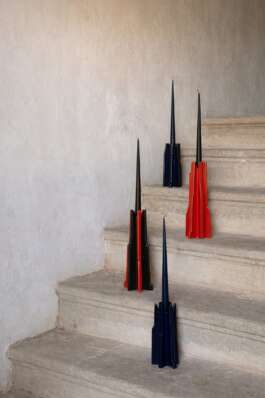
F: For this edition, I'm presenting a new tablescape collection inspired by nature, specifically Guinea-Bissau. The project was created for a private commission whose roots are in Africa, and the designs reflect a dialogue with his cultural and family heritage. The work includes vessels, candleholders, and food stands inspired by the ceiba and baobab trees, as well as platters and plates influenced by local textile patterns and cultural references.
C: What have you been up to recently? What are the next projects or exhibitions you wish to highlight?
F: I recently moved to the French countryside, where I am setting up my new atelier. I am personally renovating a 17th-century manoir and am fully dedicated to the restoration, design, and making of its ten rooms. I feel very privileged to have my studio within the space itself, allowing me to work directly on any need or even the craziest idea. Most of the work now comes directly from nature and my surroundings. I am located in a vast national park, surrounded by grass, farms, the ocean, birds, and all kinds of flowers. This new chapter for Fefostudio will be deeply connected to these encounters. Living in nature is already informing my work in a much stronger way than New York ever did.
C: How did you get into collectible design?
F: Ten years ago, when I started the studio, I was mostly producing in volume, building inventory for restaurants, hotels, and stores. Over the years, I realized this was not the right path for me. I wanted to build a brand, but at the same time I was struggling with repetition (since I make everything myself) and with the pressure of maintaining inventory. My mindset really shifted after the pandemic. I stopped having help and support, and I decided to simply be myself working on one project at a time, for clients I connect with and feel a real conversation with. Knowing that someone will live with my piece, a mural, a table, a lamp in their home feels like the right direction for me. Most of my clients have become collectors of my work. Many started with ceramics and then moved on to lamps, furniture, and murals. It means a lot to see my work living as a whole in people's spaces, rather than existing as one isolated object among many produced in high volume. That shift made everything make sense.
C: How has your practice evolved since you started working in collectible design?
F: It was a night-and-day shift. I feel my work now has a purpose. It feels meaningful and considered.
C: Where do you take your inspiration from?
F: I work purely by intuition and by observing what surrounds me. There is no act of inventing, only reinterpreting what already exists, offering a different perspective on something that already serves a purpose, by changing its use and seeing it with new eyes. Nature is my biggest driving force. Everything is there: the shapes of insects, flowers, trees. I try to bring those elements into forms that evolve in my imagination and give them a different life.

© Fefostudio

© Fefostudio
COLLECTIBLE In-Depth
Fefostudio
March 2026
This series, COLLECTIBLE In-Depth, unveils the backstage of contemporary creation. Tackling various topics from personal designer processes to the position of collectible design on the global design market, COLLECTIBLE In-Depth offers different views to suit all tastes. Today we speak with Fefostudio.
COLLECTIBLE: Why do you focus on contemporary collectible design? What does it mean to you?
Fefostudio: I prefer to work on collectible items made specially for a client. Custom work with a narrative that connects me to the person who will live with the piece. Making products at scale is not only unsustainable in terms of production and storage, but it also causes us to lose the true value of our work and the time given to each project. Personally, I put time and spirit into everything I make, so collectible design is certainly my 100% state of work these days.
C: What does collectible design bring compared to more mass-produced objects?
F: Purchasing a painting, a piece of furniture, a lamp, or any serving ware made by someone I feel connected to, or whose story I intuitively resonate with is very important to me. Buying just for the sake of buying creates more unwanted objects around us. In the end, we don't need many things; we need objects that tell a story and enrich our lives. Whatever the product, whether we need it or simply want to be in its presence, it should feel meaningful.
C: Can you talk about a new piece or collection you are presenting at COLLECTIBLE this year?
F: For this edition, I'm presenting a new tablescape collection inspired by nature, specifically Guinea-Bissau. The project was created for a private commission whose roots are in Africa, and the designs reflect a dialogue with his cultural and family heritage. The work includes vessels, candleholders, and food stands inspired by the ceiba and baobab trees, as well as platters and plates influenced by local textile patterns and cultural references.
C: What have you been up to recently? What are the next projects or exhibitions you wish to highlight?
F: I recently moved to the French countryside, where I am setting up my new atelier. I am personally renovating a 17th-century manoir and am fully dedicated to the restoration, design, and making of its ten rooms. I feel very privileged to have my studio within the space itself, allowing me to work directly on any need or even the craziest idea. Most of the work now comes directly from nature and my surroundings. I am located in a vast national park, surrounded by grass, farms, the ocean, birds, and all kinds of flowers. This new chapter for Fefostudio will be deeply connected to these encounters. Living in nature is already informing my work in a much stronger way than New York ever did.
C: How did you get into collectible design?
F: Ten years ago, when I started the studio, I was mostly producing in volume, building inventory for restaurants, hotels, and stores. Over the years, I realized this was not the right path for me. I wanted to build a brand, but at the same time I was struggling with repetition (since I make everything myself) and with the pressure of maintaining inventory. My mindset really shifted after the pandemic. I stopped having help and support, and I decided to simply be myself working on one project at a time, for clients I connect with and feel a real conversation with. Knowing that someone will live with my piece, a mural, a table, a lamp in their home feels like the right direction for me. Most of my clients have become collectors of my work. Many started with ceramics and then moved on to lamps, furniture, and murals. It means a lot to see my work living as a whole in people's spaces, rather than existing as one isolated object among many produced in high volume. That shift made everything make sense.
C: How has your practice evolved since you started working in collectible design?
F: It was a night-and-day shift. I feel my work now has a purpose. It feels meaningful and considered.
C: Where do you take your inspiration from?
F: I work purely by intuition and by observing what surrounds me. There is no act of inventing, only reinterpreting what already exists, offering a different perspective on something that already serves a purpose, by changing its use and seeing it with new eyes. Nature is my biggest driving force. Everything is there: the shapes of insects, flowers, trees. I try to bring those elements into forms that evolve in my imagination and give them a different life.

© Fefostudio