


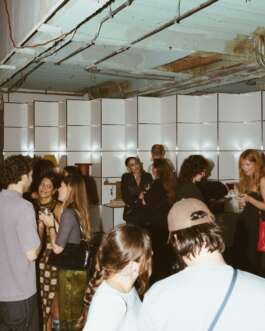
USM × Yabu Pushelberg × ENSEMBLE, installation view, COLLECTIBLE New York 2026. © Simon Leung
COLLECTIBLE In-Depth
USM × Yabu Pushelberg × ENSEMBLE
November 2026
This series, COLLECTIBLE In-Depth, unveils the backstage of contemporary creation. Tackling various topics from personal designer processes to the position of collectible design on the global design market, COLLECTIBLE In-Depth offers different views to suit all tastes. Today we speak with USM, Yabu Pushelberg and ENSEMBLE about their Special Project at COLLECTIBLE New York 2026.
Select a name to read their answers: Yabu Pushelberg, ENSEMBLE, USM

USM × Yabu Pushelberg × ENSEMBLE, COLLECTIBLE New York 2026. © Jeremy Lechatelier
"Each piece needs room to hold its own while remaining part of a larger composition."
Yabu Pushelberg
Yabu Pushelberg
COLLECTIBLE: Can you introduce the concept behind the space you are creating for COLLECTIBLE, and how you approached bringing the worlds of USM and ENSEMBLE together within it?
Yabu Pushelberg: Yabu Pushelberg’s design explores the dualities between the building’s raw, unadorned structure and the intimate, handcrafted pieces in ENSEMBLE’s collection. USM’s modular system bridges the two, providing the objects and furniture a setting that allows their individual character to come through.
USM’s precise construction and minimal detailing provide a clear framework against which the textures and proportions of ENSEMBLE’s richly crafted pieces become more apparent, accentuating their human scale.
C: Your practice often moves between interiors, objects, and larger spatial experiences. How do you approach designing a setting in which collectible objects are not simply displayed, but given their own presence and narrative?
Yabu Pushelberg: An object’s presence is shaped by its relationship to the space around it. Scale, placement, and material influence what people notice. Each piece needs room to hold its own while remaining part of a larger composition.
At COLLECTIBLE New York, Yabu Pushelberg’s design was conceived to keep the focus on ENSEMBLE’s expressive pieces. USM’s modular system works at an architectural scale, providing a backdrop for the collection.

"We like contrasts, tensions, and surprising combinations."
ENSEMBLE
ENSEMBLE
C: How would you describe ENSEMBLE’s approach to bringing together contemporary Canadian design, and what connects the objects selected for this presentation?
ENSEMBLE: ENSEMBLE was born from a desire to present design differently, outside of conventional exhibition formats. We’re interested in creating unexpected encounters between objects, disciplines, and people, and in finding new ways for design to be experienced.
We don’t necessarily look for objects that share a common aesthetic. What connects them is a certain freedom in the way their designers approach materials, forms, and function. Each piece brings its own perspective, contributing to a broader portrait of contemporary Canadian design.
For COLLECTIBLE, this diversity takes on a new dimension through our collaboration with Yabu Pushelberg and Swiss design brand USM, which is bringing to life a beautiful scenography conceived by Yabu Pushelberg. It’s an exciting meeting of different design perspectives, brought together in a shared space.
C: What do you look for in an object when building an exhibition? How do you balance the individual voice of a designer with the larger dialogue you want the objects to create together?
ENSEMBLE: We’re drawn to objects with a strong identity, a singular point of view, or something unexpected about them. It might be an unusual use of materials, a radical form, a sense of humour, or simply a very personal approach to making.
We don’t believe that a successful exhibition needs to be visually uniform. Quite the opposite. We like contrasts, tensions, and surprising combinations. Each designer should maintain their own voice, but the relationships between the pieces should create something that none of them could achieve alone.
Scenography is essential to this process. It allows us to build a narrative around the objects and influence how they’re perceived. For COLLECTIBLE, Yabu Pushelberg’s vision, beautifully realized by USM, creates a common architectural language while giving each piece the space to stand on its own.
C: What feels distinctive about the contemporary Canadian design landscape right now, and what do you hope to introduce to a New York audience through this presentation?
ENSEMBLE: There’s an incredible creative energy in Canadian design right now, particularly among independent designers and small studios. What we find exciting is the fluidity between design, craft, and art, along with a strong relationship to materials and making.
We also see a growing sense of community. Designers are increasingly finding ways to support one another, share resources, and create opportunities beyond traditional institutions. Rather than waiting for opportunities to emerge, we’ve chosen to create our own. ENSEMBLE is as much about building a community as it is about finding new ways for independent design to be seen.
Through COLLECTIBLE, we hope to introduce New York audiences to a generation of Canadian designers whose work is bold, independent, and difficult to categorize. More than presenting a particular aesthetic, we want to share the energy and diversity of a design scene that deserves greater international visibility.
Alongside COLLECTIBLE, we’re also presenting POT-AU-FEU, an exhibition bringing together over twenty designers and artists from Québec, at the Yabu Pushelberg Gallery in Tribeca from November 6–9. It’s particularly meaningful to present this new generation of Canadian talent in a space opened to us by George Yabu and Glenn Pushelberg, who helped pave the way for Canadian design on the international stage. Their generosity in welcoming us feels like a beautiful continuation of that legacy, and a reflection of the spirit of collaboration we’re trying to cultivate through ENSEMBLE.

USM × Yabu Pushelberg × ENSEMBLE, COLLECTIBLE New York 2026. © Jeremy Lechatelier
"It felt like a form of hospitality here in New York, where we have a flagship."
USM
USM
C: USM has long been associated with a modular system that can adapt to different spaces and uses. How did you approach translating that language into custom furniture and pedestals for this particular presentation?
USM: We were originally drawn to the idea of collaborating with Yabu Pushelberg, a first for us, in such a site-specific way. The lack of right angles in the theater together with the USM grid was a problem that Yabu Pushelberg solved in an elegant way, leaning into the space’s apparent challenges. We also found the restraint on the part of our gallery partner, ENSEMBLE, to work with objects and furniture that fit into 20" × 20" spaces a great match!
C: What interests USM about placing its system in dialogue with collectible design and supporting emerging or independent creative practices in this way?
USM: Some of the things USM works on are USM-forward, and with others we are happy to play a supporting role. In this instance ENSEMBLE, coming from Montreal, was happy for us to support their objects with a temporary home. It felt like a form of hospitality here in New York, where we have a flagship.
About USM × Yabu Pushelberg × ENSEMBLE
Yabu Pushelberg designs places and products: immersive environments, compelling destinations, and considered goods. George Yabu and Glenn Pushelberg founded the studio in 1980 with an emphasis on interior design and have since expanded the studio into a multidisciplinary practice that addresses multiple layers of human experience. With offices in New York and Toronto and a team of more than a hundred creatives and professionals, the studio specializes in sensibilities spanning buildings, interiors, landscapes, lighting, furniture, objects, and graphics with a focus that goes well beyond what things look like, to how they make people feel.
ENSEMBLE is a Montreal-based platform presenting contemporary Canadian design outside conventional exhibition formats.
Swiss based USM has been providing timeless modular furniture designs suitable for both home and office environments for more than 60 years. Recognized as a design classic, USM was formally accepted into The Museum of Modern Art (MoMA) Architecture and Design collection in 2001. Created from a few basic elements, the company’s furniture offers tailor-made solutions that can be expanded or reconfigured as needed. Each furniture piece allows room for maximum versatility and creativity. To encourage long-term use, all of the USM product lines are made from high-quality materials for strength and durability to last for years. Our USM Haller product line carries the Cradle-to-Cradle® certification, the leading multi-attribute standard used globally across industries for designing and making products that enable a healthy, fair and sustainable future according to the world’s most advanced science-based measures.
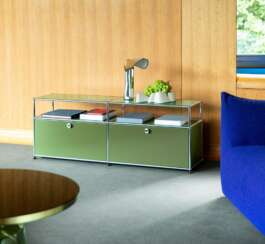
USM Haller sideboard in olive green. Courtesy of USM

USM × Yabu Pushelberg × ENSEMBLE, installation view, COLLECTIBLE New York 2026. © Simon Leung
COLLECTIBLE In-Depth
USM × Yabu Pushelberg × ENSEMBLE
November 2026
This series, COLLECTIBLE In-Depth, unveils the backstage of contemporary creation. Tackling various topics from personal designer processes to the position of collectible design on the global design market, COLLECTIBLE In-Depth offers different views to suit all tastes. Today we speak with USM, Yabu Pushelberg and ENSEMBLE about their Special Project at COLLECTIBLE New York 2026.
Select a name to read their answers: Yabu Pushelberg, ENSEMBLE, USM

USM × Yabu Pushelberg × ENSEMBLE, COLLECTIBLE New York 2026. © Jeremy Lechatelier
"Each piece needs room to hold its own while remaining part of a larger composition."
Yabu Pushelberg
Yabu Pushelberg
COLLECTIBLE: Can you introduce the concept behind the space you are creating for COLLECTIBLE, and how you approached bringing the worlds of USM and ENSEMBLE together within it?
Yabu Pushelberg: Yabu Pushelberg’s design explores the dualities between the building’s raw, unadorned structure and the intimate, handcrafted pieces in ENSEMBLE’s collection. USM’s modular system bridges the two, providing the objects and furniture a setting that allows their individual character to come through.
USM’s precise construction and minimal detailing provide a clear framework against which the textures and proportions of ENSEMBLE’s richly crafted pieces become more apparent, accentuating their human scale.
C: Your practice often moves between interiors, objects, and larger spatial experiences. How do you approach designing a setting in which collectible objects are not simply displayed, but given their own presence and narrative?
Yabu Pushelberg: An object’s presence is shaped by its relationship to the space around it. Scale, placement, and material influence what people notice. Each piece needs room to hold its own while remaining part of a larger composition.
At COLLECTIBLE New York, Yabu Pushelberg’s design was conceived to keep the focus on ENSEMBLE’s expressive pieces. USM’s modular system works at an architectural scale, providing a backdrop for the collection.
"We like contrasts, tensions, and surprising combinations."
ENSEMBLE
ENSEMBLE
C: How would you describe ENSEMBLE’s approach to bringing together contemporary Canadian design, and what connects the objects selected for this presentation?
ENSEMBLE: ENSEMBLE was born from a desire to present design differently, outside of conventional exhibition formats. We’re interested in creating unexpected encounters between objects, disciplines, and people, and in finding new ways for design to be experienced.
We don’t necessarily look for objects that share a common aesthetic. What connects them is a certain freedom in the way their designers approach materials, forms, and function. Each piece brings its own perspective, contributing to a broader portrait of contemporary Canadian design.
For COLLECTIBLE, this diversity takes on a new dimension through our collaboration with Yabu Pushelberg and Swiss design brand USM, which is bringing to life a beautiful scenography conceived by Yabu Pushelberg. It’s an exciting meeting of different design perspectives, brought together in a shared space.
C: What do you look for in an object when building an exhibition? How do you balance the individual voice of a designer with the larger dialogue you want the objects to create together?
ENSEMBLE: We’re drawn to objects with a strong identity, a singular point of view, or something unexpected about them. It might be an unusual use of materials, a radical form, a sense of humour, or simply a very personal approach to making.
We don’t believe that a successful exhibition needs to be visually uniform. Quite the opposite. We like contrasts, tensions, and surprising combinations. Each designer should maintain their own voice, but the relationships between the pieces should create something that none of them could achieve alone.
Scenography is essential to this process. It allows us to build a narrative around the objects and influence how they’re perceived. For COLLECTIBLE, Yabu Pushelberg’s vision, beautifully realized by USM, creates a common architectural language while giving each piece the space to stand on its own.
C: What feels distinctive about the contemporary Canadian design landscape right now, and what do you hope to introduce to a New York audience through this presentation?
ENSEMBLE: There’s an incredible creative energy in Canadian design right now, particularly among independent designers and small studios. What we find exciting is the fluidity between design, craft, and art, along with a strong relationship to materials and making.
We also see a growing sense of community. Designers are increasingly finding ways to support one another, share resources, and create opportunities beyond traditional institutions. Rather than waiting for opportunities to emerge, we’ve chosen to create our own. ENSEMBLE is as much about building a community as it is about finding new ways for independent design to be seen.
Through COLLECTIBLE, we hope to introduce New York audiences to a generation of Canadian designers whose work is bold, independent, and difficult to categorize. More than presenting a particular aesthetic, we want to share the energy and diversity of a design scene that deserves greater international visibility.
Alongside COLLECTIBLE, we’re also presenting POT-AU-FEU, an exhibition bringing together over twenty designers and artists from Québec, at the Yabu Pushelberg Gallery in Tribeca from November 6–9. It’s particularly meaningful to present this new generation of Canadian talent in a space opened to us by George Yabu and Glenn Pushelberg, who helped pave the way for Canadian design on the international stage. Their generosity in welcoming us feels like a beautiful continuation of that legacy, and a reflection of the spirit of collaboration we’re trying to cultivate through ENSEMBLE.

USM × Yabu Pushelberg × ENSEMBLE, COLLECTIBLE New York 2026. © Jeremy Lechatelier
"It felt like a form of hospitality here in New York, where we have a flagship."
USM
USM
C: USM has long been associated with a modular system that can adapt to different spaces and uses. How did you approach translating that language into custom furniture and pedestals for this particular presentation?
USM: We were originally drawn to the idea of collaborating with Yabu Pushelberg, a first for us, in such a site-specific way. The lack of right angles in the theater together with the USM grid was a problem that Yabu Pushelberg solved in an elegant way, leaning into the space’s apparent challenges. We also found the restraint on the part of our gallery partner, ENSEMBLE, to work with objects and furniture that fit into 20" × 20" spaces a great match!
C: What interests USM about placing its system in dialogue with collectible design and supporting emerging or independent creative practices in this way?
USM: Some of the things USM works on are USM-forward, and with others we are happy to play a supporting role. In this instance ENSEMBLE, coming from Montreal, was happy for us to support their objects with a temporary home. It felt like a form of hospitality here in New York, where we have a flagship.
About USM × Yabu Pushelberg × ENSEMBLE
Yabu Pushelberg designs places and products: immersive environments, compelling destinations, and considered goods. George Yabu and Glenn Pushelberg founded the studio in 1980 with an emphasis on interior design and have since expanded the studio into a multidisciplinary practice that addresses multiple layers of human experience. With offices in New York and Toronto and a team of more than a hundred creatives and professionals, the studio specializes in sensibilities spanning buildings, interiors, landscapes, lighting, furniture, objects, and graphics with a focus that goes well beyond what things look like, to how they make people feel.
ENSEMBLE is a Montreal-based platform presenting contemporary Canadian design outside conventional exhibition formats.
Swiss based USM has been providing timeless modular furniture designs suitable for both home and office environments for more than 60 years. Recognized as a design classic, USM was formally accepted into The Museum of Modern Art (MoMA) Architecture and Design collection in 2001. Created from a few basic elements, the company’s furniture offers tailor-made solutions that can be expanded or reconfigured as needed. Each furniture piece allows room for maximum versatility and creativity. To encourage long-term use, all of the USM product lines are made from high-quality materials for strength and durability to last for years. Our USM Haller product line carries the Cradle-to-Cradle® certification, the leading multi-attribute standard used globally across industries for designing and making products that enable a healthy, fair and sustainable future according to the world’s most advanced science-based measures.

USM Haller sideboard in olive green. Courtesy of USM